
News
On a Bi Parting Wrought Iron Gate the Fence Line Is the Foundation

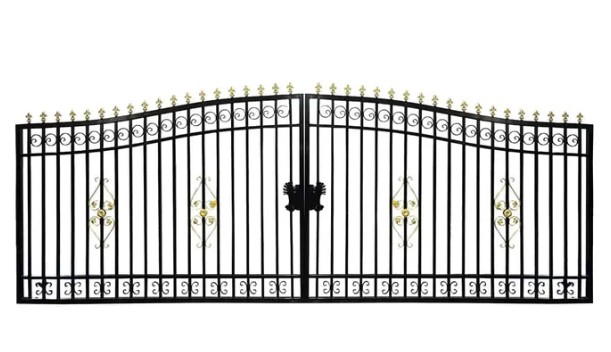
Driveway entrances are specified from the middle outward: pick a gate, then run fence to the property line. The loads travel the other way. Everything a pair of swinging leaves does arrives at two posts, and those posts are only as good as what the fence package put under them. A bi-parting ornamental wrought iron gate and fence is one structure with a gap in it, not two products that meet at the driveway.
Two leaves hang off two posts and nothing else
A swinging leaf on a wrought iron gate is a cantilever. Its weight acts at the center of the leaf, which is half the opening away from the hinge, so a gate post carries both the vertical load and a bending moment that tries to pull it over toward the driveway.
Bi parting halves the leaf length against a single gate of the same opening, which is the main structural argument for it. Each post then sees half the moment, and the gate clears a shorter arc, which matters where a driveway rises away from the road.
Footing depth is set by frost, not by gate weight
In most of Canada the controlling number is the frost line, which runs from roughly four feet in the south to deeper on the prairies. A footing that stops above it gets lifted every winter and does not come back to the same place.
Gate weight decides diameter and reinforcement. Frost decides depth. Those are separate calculations, and the common mistake is sizing a post hole generously in width while stopping it short at three feet because the auger was getting hard to turn.
What heave actually does to a gate
A post that lifts half an inch takes the gate hinges with it. On a bi parting pair that shows up as leaves that no longer meet in the middle, and the latch becomes the first thing anyone notices.
Three details reduce it:
- Bell the base of the footing below frost
- Backfill with granular material, not clay
- Keep water away from the post base
The second one matters because clay holds water against the concrete and expands as it freezes. Granular backfill drains, and a post surrounded by material that does not hold water is far less likely to be gripped and lifted.
Why a 212 foot package starts at the gate
Fence posts in a run carry very little by comparison. They resist wind on the panels and keep the line straight, which standard spacing and a modest footing handle. The two posts either side of the opening are a different component doing a different job, and in a package quoted by linear feet they are easy to treat as simply two more posts. Setting them identically to the run is the most common failure in a residential installation.
Fence post spacing is a panel question
Spacing follows the panel length rather than a rule of thumb, because ornamental panels are rigid and are not cut to fit on site without losing their end pickets. A run that does not divide evenly into panel lengths ends with a gap or a cut panel at one end.
Measuring the full run first and planning where the odd length falls is a ten minute job. Putting it at a corner or against the house is almost always better than leaving it beside the gate, where it is the first thing a visitor sees.
Slope changes the geometry before it changes anything else
Ornamental fencing handles grade in two ways: racking, where the panel parallelogram follows the slope, and stepping, where level panels descend in increments and leave triangular gaps underneath. Rackable panels suit gentle grade and look continuous. Stepping suits steeper ground and looks deliberate, but it needs a plan for the gaps if the fence is meant to contain a dog. Deciding which before ordering avoids discovering that the panels supplied do not rack.
Automation is a decision to make early
Adding a driveway gate opener later is possible and awkward. An operator needs power at the gate, a conduit run under the driveway and often a post sized for the extra load. Running conduit while the driveway is open costs almost nothing, while cutting and patching it afterwards costs more than the operator.
Reading a package past the linear feet
On a wrought iron gate package, linear feet, panel height and picket style are what get compared. Post diameter and wall thickness, hinge type, the gate post specification and whether the panels rack describe whether the installation stays square.
TMG Industrial supplies this one as a 212 linear foot package with the bi parting gate included. Treating the two gate posts as structural and the rest of the run as fencing, rather than ordering by the foot and setting everything the same, is what keeps the leaves meeting in the middle.


DJARUMTOTO Partnering With Certified Global Software Engineering Studios

On a Bi Parting Wrought Iron Gate the Fence Line Is the Foundation

10 Actionable Steps to Increase Amazon Brand Visibility This Year

Who Keeps the Jackpot? How Gambling Winnings Are Taxed in the US, the UK and Denmark

Finding Games Repetitive? Baccarat Variations Can Offer Different Experiences

What to Check Before Connecting Any MCP Server to Your Account

Step-by-Step Instructions to Check Winning Numbers on Web Portals

Corporate Gifts for Better Business Brand Promotion Now

Safer Aging at Home: A Daily Plan for Mobility, Fall Prevention, and Peace of Mind

Teeth Whitening Options: What Actually Works

BPC-157 UK: A Research-Focused Guide to the Experimental Peptide

Online Gaming and Comedy Gold: Kevin Hart Takes to the (Digital) Stage

Mexico City museums, parks and food markets: a culture-first itinerary

The Goplay711 Difference: Why Live Casino Players Are Switching

ADA Signage: What Every Business Should Know About Interior Signs

What are the Benefits of Receiving Healthcare Services at Home?


Don Toliver Net Worth: Height, Age, Real Name, Career & More
Don Toliver is an American rapper and singer best known for his RIAA platinum certified songs, No Idea and After...


Finesse2tymes Net Worth: Height, Age, Real Name & Career
Finesse2tymes is an American rapper and recording artist. He is mainly recognized for his thunderous voice and motivational lyrics in...


Sugarhill Ddot Net Worth: Height, Age, Real Name & Career
Sugarhill Ddot is an American hip-hop recording artist best known for his songs, Real Facts and I Wanna Love You....


GloRilla Net Worth: Height, Age, Bio, Real Name & Career
GloRilla is an American rapper and hip-hop recording artist from Memphis. She is best known for her popular singles, “Westside...


Destroy Lonely Net Worth: Height, Age, Real Name & Career
Destroy Lonely is an American rapper best known for his 2022 mixtape, No Stylist. He is currently signed to rapper...
-
Rappers2 years ago
GloRilla Net Worth: Height, Age, Bio, Real Name & Career
-

 News2 years ago
Trash To Treasure: Maximizing Space And Efficiency Through Junk Removal
-

 Businessman3 years ago
7 Proven Lead Generation Strategies To Implement in 2023
-
 Businessman2 years ago
Brandon Fugal Net Worth: How Rich is Skinwalker Ranch Owner?
-

 Rappers3 years ago
BigXthaPlug Net Worth: Height, Age, Real Name & Career
-

 TV Stars2 years ago
Kaleb Cooper Net Worth: How Rich is the TV Star Actually?
-

 Internet Stars4 years ago
Mufti Menk Net Worth: How Rich is the Islamic Speaker Actually?
-

 TV Stars2 years ago
Carla Diab Net Worth: How Rich is the TV Star Actually in 2025?
You must be logged in to post a comment Login