
News
Why Texas School Districts Are Prioritizing Acoustic Upgrades

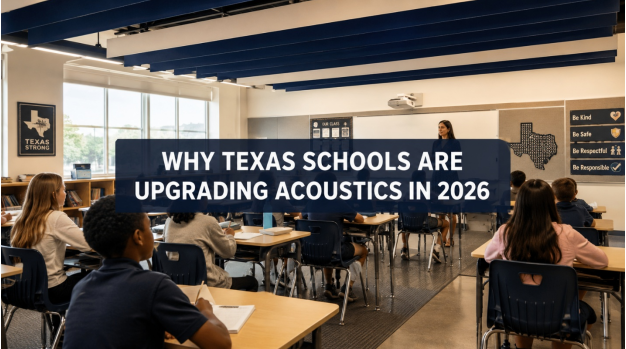
| In 2026, Texas school districts are prioritizing acoustic upgrades because most classrooms run 10 to 20 decibels above the ANSI S12.60 classroom noise standard of 35 dB(A). The result is measurably lower speech intelligibility, weaker reading outcomes, and documented teacher burnout. A record wave of school bond programs – including the $6.2 billion Dallas ISD bond approved in May 2026 – combined with expiring ESSER III federal funds and updated TEA facility expectations has made 2026 the tipping point for Texas schools to fix a problem that has been accumulating for decades. |
The Silent Infrastructure Crisis Hiding in Texas Classrooms
Walk into almost any Texas school building constructed before 2005 and you will find a noise problem hiding in plain sight. It is not the dramatic kind – no alarm, no construction outside – but a relentless, low-grade acoustic failure driven by hard tile floors, concrete block walls, bare gypsum ceilings, and HVAC units running for eight consecutive hours because it is 98°F outside.
A teacher’s voice at the front of the room registers around 65 decibels. By the time it travels to the back row, it has dropped to roughly 45 dB – with background noise often sitting at that exact same level. According to research from the Acoustical Society of America, students in these environments miss or mishear 25 to 30 percent of everything their teacher says during a normal school day.
That is not a staffing problem. That is not a curriculum problem. That is an infrastructure problem – and it is entirely fixable. Acoustic and soundproofing specialists in Texas have been solving exactly this type of challenge across commercial and educational environments statewide, and the solutions are far more accessible than most district administrators realize.
What the ANSI S12.60 Standard Requires for Texas School Classrooms
The national benchmark for school acoustic design in the United States is ANSI/ASA S12.60, first approved in 2002 and most recently reaffirmed in 2020. It establishes two hard performance limits for every core learning space:
- Maximum background noise level: 35 dB(A) in an unoccupied classroom.
- Maximum reverberation time (RT60): 6 seconds for rooms under 10,000 cubic feet; 0.7 seconds for rooms between 10,000 and 20,000 cubic feet.
These numbers exist for a specific reason. The 35 dB(A) limit is calibrated to maintain a signal-to-noise ratio (SNR) of at least +15 dB – the minimum threshold at which most children can reliably understand spoken instruction. Research published in Language, Speech, and Hearing Services in Schools (Minelli et al., 2022) confirms that when SNR drops to +5 dB or below, children under 12 years old cannot achieve satisfactory academic performance, regardless of teaching quality.
The Texas-specific compounding factor: Extreme summer heat means HVAC systems in Texas schools run far longer and at higher loads than in northern states. That mechanical load alone pushes many classrooms 10 to 15 dB above the ANSI limit before the first student walks in. A 2019 national survey found that fewer than 30 percent of existing U.S. classrooms meet ANSI S12.60 – a figure almost certainly lower in Texas’s large inventory of aging portables and 1970s-era brick campuses.
Which Texas Students Are Most Affected by Poor Classroom Acoustics
Poor classroom acoustics do not harm all students equally. Three groups carry the largest burden – and all three are disproportionately large across Texas public schools.
English Language Learners (ELL Students)
Texas public schools serve nearly 1.2 million Emergent Bilingual students, representing approximately 20 percent of total K-12 enrollment (TEA, 2022). For these students, phoneme recognition in a second language demands a meaningfully better SNR than native English speakers require. In a noisy classroom, distinguishing similar-sounding English consonants becomes almost impossible – not a focus problem, but a physics problem.
For districts serving large ELL populations, partnering with a qualified school acoustic treatment Texas to audit speech intelligibility levels across campuses is an evidence-based strategy for improving language acquisition outcomes and directly closing academic achievement gaps.
Students with APD and ADHD
Auditory Processing Disorder (APD) affects roughly 5 percent of school-age children, while ADHD affects approximately 11 percent in Texas (CDC state-level data). Both conditions make background noise disproportionately costly. For these students, a reverberant and noisy classroom does not just impede concentration – it collapses it entirely, consuming the cognitive bandwidth needed for actual learning.
Pre-K Through Grade 2 Early Learners
Children’s auditory processing systems continue maturing until around age 15. Younger children need a substantially higher SNR than adults to reach the same comprehension level. A 2024 systematic review published in Frontiers in Psychology confirmed that both speech-type and non-speech noise negatively affect children’s verbal working memory and reading ability – the two skills most critical for early literacy development.
For a state actively expanding Pre-K access under House Bill 1525, building new early childhood classrooms without adequate acoustic design is a false economy that compounds learning gaps from day one.
Why 2026 Is the Tipping Point – Not Just Another Year for Texas Schools
Districts have been aware of ANSI S12.60 since 2002. So why is 2026 the year Texas is actually moving? Four converging pressures explain the shift.
1. The Largest School Bond Cycle in Texas History
School bonds are the primary vehicle for capital improvements in Texas, and the 2026 cycle is the most active in state history:
- Dallas ISDvoters approved a record $6.2 billion bond in May 2026 – the largest school bond in Texas history – with explicit scope for upgrading aging campuses and modernizing learning environments.
- Houston ISD’s $4.4 billion bondincluded acoustic technicians as a named subcontractor category for the first time in the district’s history.
- Birdville ISD Bond 2026, Arlington ISD’s $501 millionpackage, and multiple active programs statewide now name “acoustical treatments” as a specific line item – something absent from most bond language before 2020.
2. ESSER III Funds Must Be Obligated by September 2026
Federal COVID relief under ESSER III must be obligated by September 30, 2026. Acoustic retrofits qualify directly as “healthy and safe school environment” expenditures under ESSER program guidance. Districts with unspent balances have a narrow, closing window to commit those dollars to classroom sound treatment before they revert to the federal government.
3. Post-COVID HVAC Upgrades Exposed Hidden Acoustic Failures
Ventilation improvements mandated after COVID opened ceilings across Texas campuses. What districts found was not just aging ductwork – it was the complete absence of acoustic insulation above the ceiling plane. In many cases, the new higher-capacity fans installed for air quality improvement made background noise measurably worse before the acoustic issue was even identified.
4. The Open-Plan Classroom Correction Era
The open-plan school design trend of 2012 to 2020 produced hundreds of Texas classrooms without interior walls. Without walls, there is nothing to absorb or contain sound. Texas school architects now describe 2026 as the “open-plan correction era” – a focused campaign to retrofit these echo-prone spaces with acoustic partitions, ceiling baffles, and wall treatment panels.
What Classroom Acoustic Upgrades Include – And What They Cost in Texas
Understanding what a school acoustic upgrade involves helps administrators write accurate budget requests and evaluate contractor proposals with confidence. Most Texas classroom projects involve some combination of the following treatments, selected based on each building’s specific conditions.
Ceiling Treatments – Highest Priority
Suspended acoustic baffles, ceiling clouds, and high-NRC ceiling tile replacements are typically the first and highest-impact intervention. The target for classroom ceiling systems is an NRC (Noise Reduction Coefficient) rating of 0.85 or above. On Texas campuses, mold-resistant product specifications are essential due to humidity cycling between outdoor summer heat and air-conditioned interiors.
Acoustic Wall Panels
Fabric-wrapped fiberglass panels, wood slat systems with mineral wool backing, and perforated metal panel arrays all reduce first-reflection echo. Panel placement strategy matters more than quantity. Panels positioned at mirror-reflection points on side walls deliver far greater improvement than randomly distributed panels of the same total area.
HVAC Noise Control – The Most Texas-Specific Fix
Duct lining, vibration isolation pads for air handling units, and properly selected supply diffusers can reduce mechanical background noise by 8 to 12 dB – often enough to bring a room into ANSI S12.60 compliance before any surface treatments are applied. This is the most commonly overlooked and highest-leverage intervention in Texas school acoustics.
Classroom Audio Distribution (CAD) Systems
Ceiling-mounted speaker arrays paired with a wireless teacher microphone deliver consistent speech levels across the full room regardless of teacher position. CAD systems are standard in large secondary classrooms and required under IDEA for rooms serving students with hearing devices. Typical installed cost: $3,500 to $8,000 per room.
Door and Window Acoustic Sealing
Corridor noise infiltration through door gaps is one of the cheapest and most impactful fixes available. Door sweeps, acoustic perimeter seals, and STC-rated door replacements can be completed for $300 to $800 per opening – often the best first step for districts with constrained budgets.
Estimated Cost Breakdown Per Classroom in Texas:
| Upgrade Type | Estimated Cost Per Room |
| Ceiling baffles or acoustic clouds | $2,000 – $6,000 |
| Acoustic wall panels | $1,500 – $5,000 |
| CAD classroom audio distribution system | $3,500 – $8,000 |
| HVAC noise control – duct lining and vibration isolation | $1,000 – $4,000 |
| Door and window acoustic sealing | $300 – $800 |
| Full room retrofit (basic) | $8,000 – $15,000 |
| Full room retrofit (comprehensive) | $15,000 – $40,000 |
The Teacher Retention Connection Texas Districts Are Missing
Texas loses approximately 19 percent of teachers within their first three years, with burnout ranked as the leading contributing factor (TEA Educator Workforce Data). Classroom noise is a direct, documented driver – not through abstract job satisfaction metrics, but through measurable physical damage.
Research published in ScienceDirect found that 64.4 percent of teachers studied showed likely symptoms of a voice disorder. The most prevalent symptoms reported were:
- Hoarseness– reported by 84.4 percent of affected teachers.
- Fatigue when speaking– reported by 82.1 percent of affected teachers.
- Dry throat and loss of vocal power– reported consistently above 80 percent.
A separate pilot study published in PLOS ONE confirmed that higher ventilation system noise in classrooms was directly associated with higher burnout scores among primary school teachers.
The harm chain works as follows:
- A loud classroom forces teachers to raise their voice consistently throughout the school day.
- Sustained elevated vocal effort leads to nodules, chronic laryngitis, and dysphonia.
- Extended sick leave or FMLA absence follows, often mid-term.
- A substitute teacher steps in and breaks the continuity of instruction.
- Students lose academic ground that is difficult to recover within the same school year.
For district administrators calculating the true ROI on acoustic renovation, substitute teacher costs of $150 to $250 per day per position, FMLA-related staffing gaps, and early attrition replacement costs all belong in the calculation – not just the material cost of ceiling panels.
How Texas School Districts Are Funding Acoustic Upgrades in 2026
Texas districts have more funding pathways available for acoustic renovation than most administrators recognize. The five most practical options in the 2026 funding environment are:
- Voter-Approved School Bonds. The primary vehicle for capital expenditure in Texas. Acoustic work qualifies as a capital improvement when explicitly named in bond language as “acoustical treatments” or “instructional environment improvements.” Districts that leave acoustics as a general renovation subcategory risk having it cut when bond scopes are trimmed during value engineering.
- TEA Instructional Facilities Allotment (IFA). Available to districts with property wealth below $275,000 per WADA. Acoustic renovation qualifies under instructional environment improvement. Applications are reviewed annually with a September deadline.
- ESSER III Remaining Funds. The obligation deadline is September 30, 2026. Acoustic retrofits qualify as “healthy and safe school environment” expenditures. Districts with unspent ESSER balances should contact their TEA program coordinator immediately to confirm eligibility and timeline.
- IDEA-B Funds. Available for classrooms serving students with IEPs that include auditory processing accommodations. Classroom Audio Distribution (CAD) systems and FM hearing loop installations qualify directly under this stream – making it particularly relevant for campuses with high APD or hearing-related IEP populations.
- Utility Rebate Programs. Oncor, AEP Texas, and CenterPoint Energy all offer commercial energy efficiency rebates. When HVAC noise control work – duct insulation, VAV system optimization, vibration isolation – is bundled with energy efficiency upgrades, utility rebate programs can offset 15 to 30 percentof the mechanical acoustic treatment cost. This bundling strategy is underused and fully legitimate.
Does Your Texas School Campus Need Acoustic Upgrades? A 9-Point Self-Assessment
Before engaging an acoustic consultant, this checklist helps identify which campuses need priority attention. Any campus where four or more of the following statements are true warrants a formal acoustic audit.
- Campus buildings are more than 20 years old with original HVAC units and ceiling systems still in place.
- Teachers regularly report needing to repeat instructions or raise their voice during a typical lesson.
- Portable or modular classrooms are being used for permanent core instructional programs.
- Background noise is clearly audible on standard video recordings made during classroom instruction.
- The campus ELL or Emergent Bilingual population exceeds 15 percent of total enrollment.
- IEP or 504 accommodation requests citing auditory processing difficulties have increased in the past two academic years.
- The campus received HVAC upgrades between 2021 and 2023 that introduced new or higher-capacity mechanical equipment.
- Open-plan or flexible learning spaces are in active use without acoustic partition treatment or overhead baffles.
- A teacher on the campus has taken extended leave for a vocal cord condition within the past three academic years.
Most regional Education Service Centers (ESCs) in Texas now offer free or reduced-cost acoustic assessments for member districts – a cost-free first step before committing to a paid independent consultant.
ANSI S12.60 Compliance Is a Floor, Not the Finish Line
Meeting ANSI S12.60 is the minimum acceptable standard for classroom acoustics – not the benchmark for a high-performing instructional environment. For Texas districts with large ELL populations, significant APD and ADHD representation, or active Pre-K expansion programs, reaching 35 dB(A) and an RT60 of 0.6 seconds is where the work begins, not where it ends.
A more precise performance metric is the Speech Transmission Index (STI), which directly measures how well a teacher’s voice is preserved from source to listener across the full classroom. ASHA recommends an STI of 0.75 or above for primary learning spaces. Measuring STI – rather than background noise levels alone – provides a far more accurate picture of whether a classroom genuinely supports instruction or simply passes a compliance threshold.
The Texas districts that will see the strongest academic return on acoustic investment in 2026 are not the ones that barely clear the minimum. They are the ones that recognize the acoustic environment as infrastructure as fundamental to learning outcomes as the curriculum itself.
Frequently Asked Questions
Why are Texas school districts spending money on acoustics?
A record 2026 school bond cycle, the September 30, 2026 ESSER III obligation deadline, post-COVID HVAC renovations that revealed hidden acoustic failures, and updated TEA facility standards have all converged simultaneously – creating a funded and policy-driven window for Texas districts to act.
What is the ANSI standard for classroom acoustics?
ANSI/ASA S12.60 requires background noise in unoccupied classrooms to not exceed 35 dB(A) and reverberation time (RT60) to stay at or below 0.6 seconds. Fewer than 30 percent of existing U.S. classrooms currently meet this standard.
How does classroom noise affect student learning outcomes?
Excessive noise reduces speech intelligibility below functional learning thresholds, impairs verbal working memory, and disrupts phonological development in early readers. Students in non-compliant classrooms miss or mishear up to 30 percent of instruction each day.
How much does it cost to soundproof a classroom in Texas?
A basic acoustic retrofit runs $8,000 to $15,000 per room. A comprehensive renovation including HVAC noise control and a CAD audio system ranges from $15,000 to $40,000 per classroom, depending on building conditions and specification level.
Does ESSER funding cover school acoustic upgrades?
Yes. Acoustic retrofits qualify as “healthy and safe school environment” expenditures under ESSER III. The obligation deadline is September 30, 2026. Districts with remaining balances should contact their TEA program coordinator without delay.
What are acoustic panels for classrooms and how do they work?
Acoustic panels are sound-absorbing surfaces – typically fabric-wrapped fiberglass or mineral wool – installed on classroom walls or suspended from ceilings. They reduce echo by converting sound energy to heat upon contact, lowering reverberation time and improving the signal-to-noise ratio teachers and students need for clear communication.
Are Texas schools required to meet acoustic standards?
ANSI S12.60 is a voluntary national standard, not a Texas legal mandate. However, TEA facility guidelines for new construction and major renovations increasingly reference it, and districts pursuing bond-funded upgrades are expected to demonstrate alignment with its noise and reverberation requirements.


10 Actionable Steps to Increase Amazon Brand Visibility This Year

Who Keeps the Jackpot? How Gambling Winnings Are Taxed in the US, the UK and Denmark

Finding Games Repetitive? Baccarat Variations Can Offer Different Experiences

What to Check Before Connecting Any MCP Server to Your Account

Step-by-Step Instructions to Check Winning Numbers on Web Portals

Corporate Gifts for Better Business Brand Promotion Now

Understanding Single-Account Gaming Platforms and Their Benefits

How Pay Per Lead Loan Affiliate Programs Create New Revenue Opportunities

Safer Aging at Home: A Daily Plan for Mobility, Fall Prevention, and Peace of Mind

Teeth Whitening Options: What Actually Works

BPC-157 UK: A Research-Focused Guide to the Experimental Peptide

Online Gaming and Comedy Gold: Kevin Hart Takes to the (Digital) Stage

Mexico City museums, parks and food markets: a culture-first itinerary

The Goplay711 Difference: Why Live Casino Players Are Switching

What are the Benefits of Receiving Healthcare Services at Home?

How Trauma Therapy Works: Methods, Timelines & What to Expect


Don Toliver Net Worth: Height, Age, Real Name, Career & More
Don Toliver is an American rapper and singer best known for his RIAA platinum certified songs, No Idea and After...


Finesse2tymes Net Worth: Height, Age, Real Name & Career
Finesse2tymes is an American rapper and recording artist. He is mainly recognized for his thunderous voice and motivational lyrics in...


Sugarhill Ddot Net Worth: Height, Age, Real Name & Career
Sugarhill Ddot is an American hip-hop recording artist best known for his songs, Real Facts and I Wanna Love You....


GloRilla Net Worth: Height, Age, Bio, Real Name & Career
GloRilla is an American rapper and hip-hop recording artist from Memphis. She is best known for her popular singles, “Westside...


Destroy Lonely Net Worth: Height, Age, Real Name & Career
Destroy Lonely is an American rapper best known for his 2022 mixtape, No Stylist. He is currently signed to rapper...
-
Rappers2 years ago
GloRilla Net Worth: Height, Age, Bio, Real Name & Career
-

 News2 years ago
Trash To Treasure: Maximizing Space And Efficiency Through Junk Removal
-

 Businessman3 years ago
7 Proven Lead Generation Strategies To Implement in 2023
-
 Businessman2 years ago
Brandon Fugal Net Worth: How Rich is Skinwalker Ranch Owner?
-

 Rappers3 years ago
BigXthaPlug Net Worth: Height, Age, Real Name & Career
-

 TV Stars2 years ago
Kaleb Cooper Net Worth: How Rich is the TV Star Actually?
-

 Internet Stars4 years ago
Mufti Menk Net Worth: How Rich is the Islamic Speaker Actually?
-

 TV Stars2 years ago
Carla Diab Net Worth: How Rich is the TV Star Actually in 2025?
You must be logged in to post a comment Login