
Articles
ADA Signage: What Every Business Should Know About Interior Signs

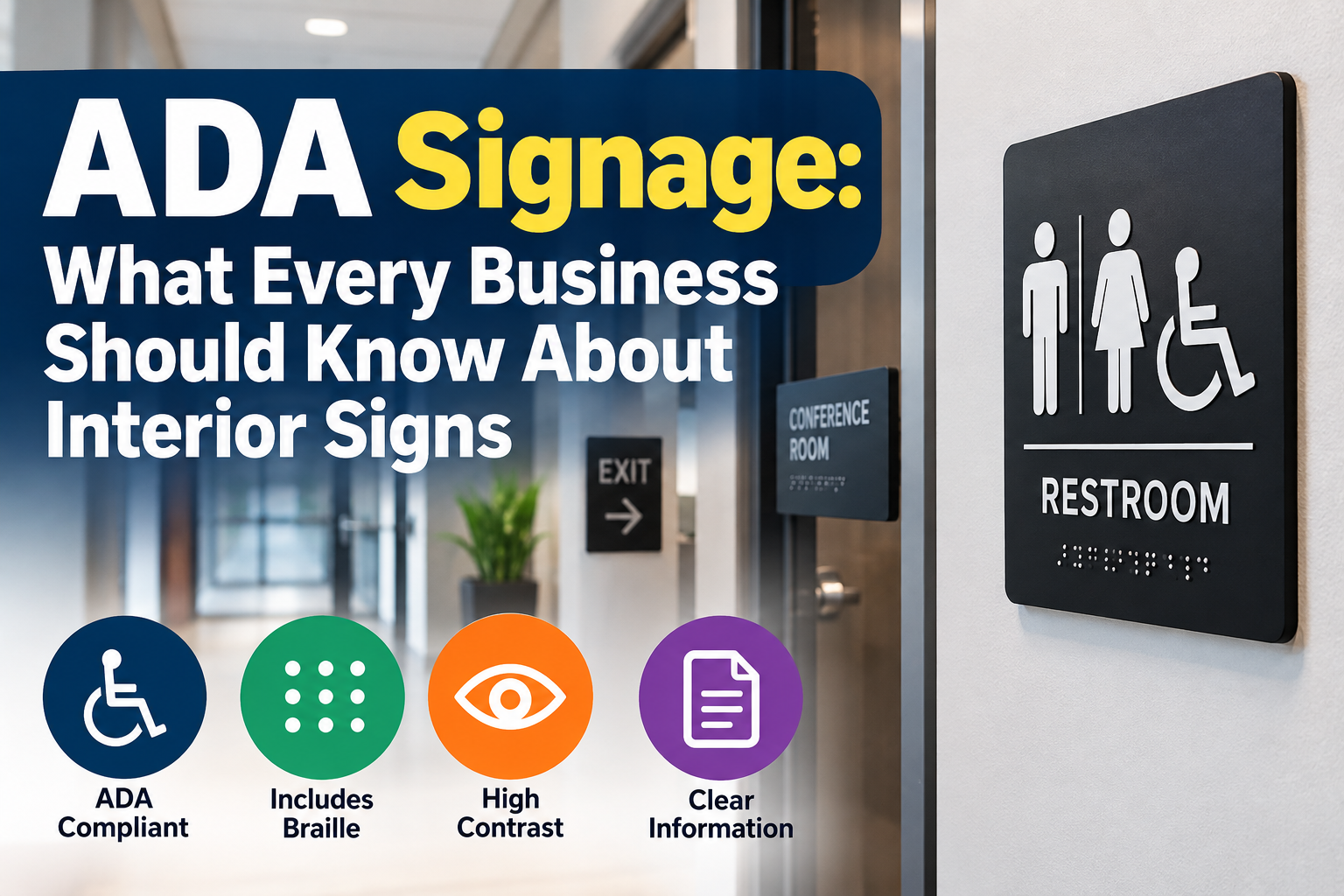
Most business owners think about signage in terms of branding. Interior signs carry a second obligation: accessibility. The Americans with Disabilities Act sets standards for permanent interior signs, and those requirements are frequently missed in otherwise well-designed spaces. Getting them wrong can mean complaints, failed inspections, and the cost of replacing signs that were only recently installed.
Which Signs Are Covered
The standards apply to signs identifying permanent rooms and spaces: restrooms, stairwells, exits, room numbers, and similar labels. Directional and informational signs, such as wayfinding to a department, have their own visual requirements but do not need tactile characters. Temporary signs, company logos, and marketing displays generally fall outside the requirements.
The Requirements in Plain Terms
- Tactile characters must be raised so they can be read by touch, and they must be accompanied by Grade 2 Braille.
- Characters must be uppercase, in a sans serif font, without italic, script, or highly decorative styling.
- Finishes must be non-glare, with strong contrast between the characters and their background.
- Tactile signs are mounted within a specified height range and, where possible, on the latch side of a door so someone can reach the sign without standing in the door’s swing.
- Pictograms, where used, need a text description placed below the pictogram field.
These details are specific enough that small deviations create problems. A stylish serif font on a restroom sign or a glossy finish that reflects overhead lighting can be enough to put a sign out of compliance.
Where Businesses Get Caught
Two situations account for most issues. The first is a remodel: new finishes go in, signs are replaced to match the updated design, and accessibility gets overlooked in favor of aesthetics. The second is a business moving into an existing space and assuming the previous tenant’s signs were compliant, which is often not the case in older buildings.
Design and Compliance Can Coexist
Accessible signage does not have to look institutional. Material, color, shape, and mounting all leave room for design, and a well-made ADA sign can match a brand’s look while meeting the standards. The constraints apply mainly to character style, contrast, finish, and placement.
Getting It Right the First Time
Work with a sign company that produces ADA and tactile signage regularly and can confirm the requirements that apply to your building and jurisdiction, since state and local codes sometimes add rules beyond the federal standards. In Los Angeles, LA Sign Company produces ADA and tactile signage among its custom sign products and has worked in the industry for over 20 years.
Final Thoughts
Accessible signage is a small part of a buildout budget and an easy thing to fix before installation rather than after. Identify which signs are covered, confirm the current standards, and treat compliance as a design input from the start rather than a correction later.
This article is general information. Confirm current ADA standards and local requirements for your project.


ADA Signage: What Every Business Should Know About Interior Signs

Verified-Purity Peptide Materials for Accurate Research

Coinspaid Dev’s Alexey Tulia on Who Answers for AI Agents in Production
How Mexican carriers connect the US and Mexico: Routes, hubs and what to expect

Mexico City museums, parks and food markets: a culture-first itinerary

Want to Smell Like a Celebrity? Start With the Scent Profile, Not the Label

How Bigger Match Payouts Actually Change FC 27 Weekend Prep

A Guide to Warrants, Arrests and the Criminal Process in Arizona

Earrings for Men: The Complete Style Guide to Wearing Studs and Hoops in 2026

BPC-157 UK: A Research-Focused Guide to the Experimental Peptide

Safer Aging at Home: A Daily Plan for Mobility, Fall Prevention, and Peace of Mind

Smart Tax Planning Moves Every Business Owner Should Make This Fall

The Hidden Economics Behind Profitable Commercial Cleaning Startups

Teeth Whitening Options: What Actually Works

Online Gaming and Comedy Gold: Kevin Hart Takes to the (Digital) Stage

Why Wealthy Entrepreneurs Prefer Recurring Revenue Franchises Over Risky Startups


Don Toliver Net Worth: Height, Age, Real Name, Career & More
Don Toliver is an American rapper and singer best known for his RIAA platinum certified songs, No Idea and After...


Finesse2tymes Net Worth: Height, Age, Real Name & Career
Finesse2tymes is an American rapper and recording artist. He is mainly recognized for his thunderous voice and motivational lyrics in...


Sugarhill Ddot Net Worth: Height, Age, Real Name & Career
Sugarhill Ddot is an American hip-hop recording artist best known for his songs, Real Facts and I Wanna Love You....


GloRilla Net Worth: Height, Age, Bio, Real Name & Career
GloRilla is an American rapper and hip-hop recording artist from Memphis. She is best known for her popular singles, “Westside...


Destroy Lonely Net Worth: Height, Age, Real Name & Career
Destroy Lonely is an American rapper best known for his 2022 mixtape, No Stylist. He is currently signed to rapper...
-
Rappers2 years ago
GloRilla Net Worth: Height, Age, Bio, Real Name & Career
-

 News2 years ago
Trash To Treasure: Maximizing Space And Efficiency Through Junk Removal
-

 Businessman3 years ago
7 Proven Lead Generation Strategies To Implement in 2023
-
 Businessman2 years ago
Brandon Fugal Net Worth: How Rich is Skinwalker Ranch Owner?
-

 Rappers3 years ago
BigXthaPlug Net Worth: Height, Age, Real Name & Career
-

 TV Stars2 years ago
Kaleb Cooper Net Worth: How Rich is the TV Star Actually?
-

 Internet Stars4 years ago
Mufti Menk Net Worth: How Rich is the Islamic Speaker Actually?
-

 TV Stars2 years ago
Carla Diab Net Worth: How Rich is the TV Star Actually in 2025?
You must be logged in to post a comment Login