
Articles
New Analysis Reveals the States with the Highest Teen DUI Risks

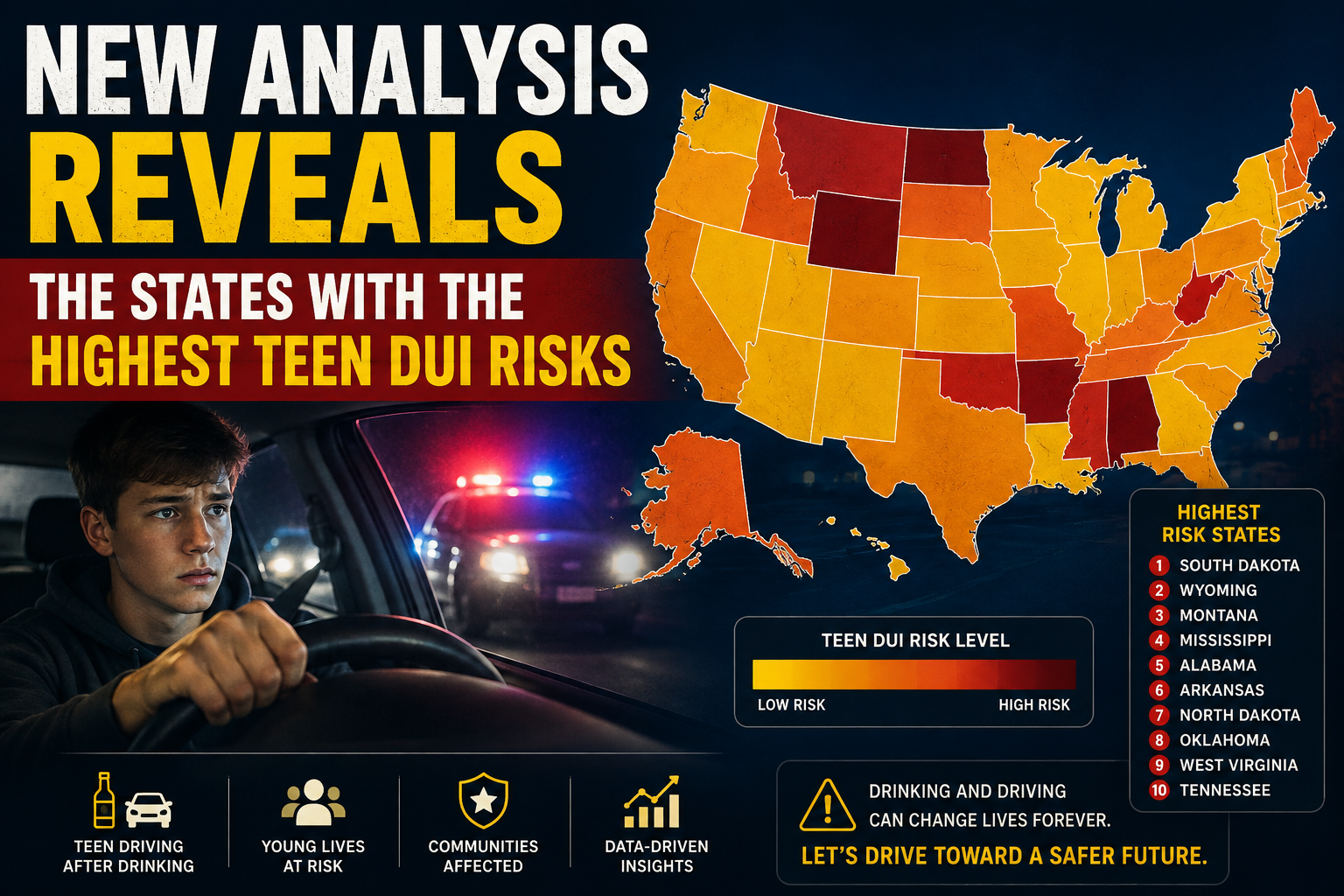
The legal drinking age may be 21 nationwide, but the rules surrounding underage alcohol consumption are far from uniform across the United States.
A study created by Jones & Swanson examined how state laws governing underage drinking differ across the country and how those differences intersect with broader trends in teen alcohol use and impaired driving.
The findings reveal a complicated national picture. Thirty-one states allow underage alcohol consumption under certain circumstances, while others prohibit minors from possessing or consuming alcohol altogether. At the same time, alcohol remains the most commonly used substance among Americans under 21, despite substantial declines in teen drinking over the past two decades.
The consequences become particularly serious when young people get behind the wheel. Between 2020 and 2024, 1,828 impaired drivers ages 16 to 19 were involved in fatal crashes, with rates varying dramatically from one state to another.
Underage Drinking Has Declined, but Alcohol Remains Common Among Teens
The United States has maintained a nationwide minimum legal drinking age of 21 since the National Minimum Drinking Age Act of 1984.
That standard followed a period in which many states experimented with lower drinking ages. Between 1970 and 1975, 29 states reduced their minimum legal drinking age to between 18 and 20. Studies at the time found that crashes involving young people increased in states that lowered their drinking age.
The shift back to 21 produced measurable changes. States that increased their minimum drinking age before the national requirement experienced a 16% reduction in road crashes, while alcohol consumption among younger Americans subsequently declined.
Between 1985 and 1991, alcohol use among 18- to 20-year-olds fell from 59% to 40%. Among people ages 21 to 25, it declined from 70% to 56%.
More recent figures show that teen drinking has continued to trend downward. However, alcohol remains a significant part of youth substance use.
In a 2023 survey of high school students, 22% reported consuming alcohol during the previous 30 days, compared with 17% who used electronic vapor products, 17% who used marijuana and 4% who smoked cigarettes.
Driving remains one of the clearest areas of concern. Sixteen percent of students said they had ridden in a vehicle with a driver who had been drinking during the previous month, while 5% of students who drove reported driving after consuming alcohol.
Underage Drinking Laws Differ Sharply by State
Although 21 is the legal drinking age nationwide, state law determines many of the circumstances under which a person younger than 21 may legally possess or consume alcohol.
The Jones & Swanson study found that 31 states permit underage alcohol consumption under specific exceptions.
Those exceptions can include drinking in a private residence under parental supervision, religious ceremonies, educational purposes or situations involving a spouse or guardian of legal drinking age.
The differences can be substantial.
States including Alabama, Florida, Kansas, Michigan and Utah do not allow minors to possess or consume alcohol under the circumstances examined in the study.
Georgia takes a different approach. Minors can possess alcohol at home when accompanied by a parent or guardian, but they cannot legally consume it under that exception.
Massachusetts and New York allow minors to possess alcohol when accompanied by a parent or guardian, while South Carolina permits minors to both possess and consume alcohol at home when accompanied by a parent or guardian.
Hawaii and New Jersey also permit minors to possess and consume alcohol in private settings.
The result is a national drinking age that appears uniform at first glance but contains considerable state-level variation once specific exceptions are considered.
Millions of Young Americans Have Consumed Alcohol
The prevalence of underage drinking provides important context for those laws.
In 2024, approximately 7 in 10 people who consumed alcohol for the first time during the previous year were under 21. That represented roughly 3 million of the 4.2 million first-time drinkers.
Another 1.7 million adolescents between ages 12 and 17, or 6.4% of that population, reported having their first alcoholic drink.
Overall, 12.7 million Americans ages 12 to 20, or 32.9%, reported having consumed alcohol at least once.
There were also differences by gender.
| Group | Share Reporting Alcohol Consumption |
|---|---|
| Females ages 12–20 | 34.4% |
| Males ages 12–20 | 31.4% |
Previous-month drinking was also slightly higher among females, at 14.3% compared with 12.4% among males. Binge drinking followed the same pattern, affecting 8.3% of females compared with 7.1% of males.
The Health Effects Extend Beyond Drinking and Driving
The consequences associated with underage drinking extend well beyond traffic safety.
In 2024, 3% of adolescents ages 12 to 17, representing approximately 775,000 young people, had experienced an Alcohol Use Disorder during the previous year.
Another 7.6%, or 2.9 million underage people, reported binge drinking during the previous month, while 1.5%, or 576,000, were classified as heavy alcohol consumers.
Mental health data also shows substantial overlap between depression and substance use.
In 2024, 792,000 adolescents ages 12 to 17 experienced both a major depressive episode and a substance use disorder. More than a quarter, 27.9%, received treatment for neither condition, while only 18.1% received treatment for both.
Young people experiencing a major depressive episode were also substantially more likely to report substance use.
| Substance | Adolescents With MDE | Adolescents Without MDE |
|---|---|---|
| Illicit drugs, previous year | 32.6% | 11.6% |
| Marijuana, previous year | 25.0% | 7.8% |
| Opioid misuse, previous year | 2.8% | 1.3% |
| Alcohol, previous month | 6.2% | 3.0% |
| Tobacco/nicotine vape, previous month | 16.9% | 4.7% |
Starting to drink at an early age may also carry longer-term consequences. Individuals who began drinking before age 15 developed alcohol dependence at four times the rate of those who began drinking at age 20 or older.
Montana Has the Highest Teen Impaired-Driving Fatal Crash Rate
Between 2020 and 2024, 1,828 drivers ages 16 to 19 who were under the influence of alcohol, drugs and/or medication were involved in fatal crashes.
Jones & Swanson compared the cumulative number of impaired teen drivers involved in fatal crashes with each state’s 2024 population ages 16 to 19.
Montana recorded the highest rate in the country at 69.08 impaired teen drivers involved in fatal crashes per 100,000 residents ages 16 to 19.
That was nearly twice Vermont’s second-highest rate of 34.81.
States With the Highest Teen Impaired-Driving Fatal Crash Rates
| Rank | State | Population Ages 16–19 | Fatal Crash Involvements | Rate per 100,000 |
|---|---|---|---|---|
| 1 | Montana | 56,457 | 39 | 69.08 |
| 2 | Vermont | 34,472 | 12 | 34.81 |
| 3 | Colorado | 307,115 | 94 | 30.61 |
| 4 | Wyoming | 32,422 | 9 | 27.76 |
| 5 | Alaska | 36,908 | 10 | 27.09 |
| 6 | Delaware | 53,981 | 14 | 25.94 |
| 7 | Idaho | 123,641 | 25 | 20.22 |
| 8 | Nevada | 158,097 | 30 | 18.98 |
| 9 | South Carolina | 292,107 | 47 | 16.09 |
| 10 | Kentucky | 238,902 | 38 | 15.91 |
At the opposite end of the rankings, New Hampshire recorded the lowest rate at just 1.49 per 100,000, based on one impaired teen driver involved in a fatal crash during the five-year period.
States With the Lowest Teen Impaired-Driving Fatal Crash Rates
| Rank | State | Population Ages 16–19 | Fatal Crash Involvements | Rate per 100,000 |
|---|---|---|---|---|
| 1 | New Hampshire | 67,055 | 1 | 1.49 |
| 2 | Maryland | 324,848 | 8 | 2.46 |
| 3 | New York | 981,626 | 37 | 3.77 |
| 4 | Illinois | 673,428 | 26 | 3.86 |
| 5 | Massachusetts | 380,404 | 15 | 3.94 |
| 6 | New Jersey | 475,728 | 21 | 4.41 |
| 7 | Virginia | 462,211 | 22 | 4.76 |
| 8 | Rhode Island | 60,755 | 3 | 4.94 |
| 9 | Utah | 231,443 | 12 | 5.18 |
| 10 | Ohio | 616,702 | 33 | 5.35 |
The difference between the two ends of the rankings is striking. Montana’s rate was more than 46 times New Hampshire’s, demonstrating just how uneven impaired teen fatal-crash involvement is across the country.
Young Male Drivers Face a Disproportionate Fatal-Crash Risk
Gender is another major dividing line in the data.
Young male drivers were involved in fatal crashes at a rate of 60.94 per 100,000 licensed drivers, compared with 22.47 among young female drivers.
Among drivers ages 15 to 20 involved in fatal crashes, 24% of males and 17% of females had been drinking before driving. Overall, 17% had a blood alcohol concentration of 0.08% or higher.
Recent arrest data points to the same gender disparity. Between May 15, 2025, and May 15, 2026, there were 4,583 DUI arrests among people ages 10 to 17, including 3,489 males and 1,094 females.
That means males accounted for roughly three-quarters of the arrests included in the study.
Summer Emerges as a Particularly Dangerous Period
The data also reveals a seasonal pattern.
Monthly figures examined in the Jones & Swanson study show impaired teen involvement in fatal crashes rising considerably as summer approaches.
June recorded the highest figure, with 209 impaired teen drivers involved in fatal crashes and a rate of 1.16, followed by May with 176 and August with 170.
| Month | Rate | Total |
|---|---|---|
| January | 0.61 | 110 |
| February | 0.68 | 122 |
| March | 0.65 | 116 |
| April | 0.71 | 127 |
| May | 0.98 | 176 |
| June | 1.16 | 209 |
| July | 0.87 | 156 |
| August | 0.95 | 170 |
| September | 0.96 | 173 |
| October | 0.91 | 163 |
| November | 0.81 | 146 |
| December | 0.89 | 160 |
The summer increase coincides with broader concerns about teen driving during the period between Memorial Day and Labor Day. In 2024 alone, 2,636 people were killed in crashes involving teen drivers, including 825 deaths during that summer period.
Teen Drinking Is Falling Across the U.S.
Despite the fatal-crash disparities, the longer-term trend in youth drinking is moving in a more encouraging direction.
Previous-month alcohol consumption among Americans ages 12 to 20 declined from 15.6% in 2021 to 13.3% in 2024.
The decline becomes even clearer when comparing current drinking habits with those recorded at the beginning of the century.
Since 2000, past-year alcohol use has fallen:
- Among 12th graders, from 73% to 41%
- Among 10th graders, from 65% to 24%
- Among 8th graders, from 43% to 11%
Binge drinking has fallen even more sharply.
Among 12th graders, the share reporting five or more drinks in a row declined from 30% to 9%. Among 10th graders, it dropped from 24% to 2%, while the rate among eighth graders declined from 12% to 1%.
Attitudes toward drinking appear to be changing alongside behavior. In 2025, 76% of students said their peers disapproved of weekend binge drinking.
At the same time, binge-drinking rates reached historically low levels, with 1.4% of eighth graders, 3.9% of 10th graders and 8.7% of 12th graders reporting five or more drinks in a row during the previous two weeks.
A National Drinking Age, but Very Different State-Level Risks
The data analyzed by Jones & Swanson shows two trends unfolding simultaneously.
On one hand, underage drinking and binge drinking have declined substantially over the past two decades, accompanied by increasingly negative attitudes toward excessive alcohol consumption among young people.
On the other, alcohol remains the most commonly used substance among Americans under 21, and impaired driving continues to create risks for teens and other road users.
Those risks are also highly uneven geographically. Montana’s impaired teen fatal-crash involvement rate stands far above the rest of the country, while states including New Hampshire, Maryland and New York record rates at the opposite end of the spectrum.
Meanwhile, the legal framework itself remains fragmented. Although every state maintains a minimum legal drinking age of 21, 31 states allow some form of exception to underage alcohol restrictions, creating markedly different rules depending on where a young person lives.
The Jones & Swanson study ultimately highlights a national trend that is moving in the right direction, but not uniformly. Teen alcohol consumption is declining, binge drinking has fallen dramatically, and peer attitudes are becoming less accepting of excessive drinking.


America’s Maternal Mental Health Crisis Is Growing

New Analysis Reveals the States with the Highest Teen DUI Risks

When Major Events Push City Traffic to the Breaking Point

America’s Wildfire Crisis Is Becoming More Costly and Complex

Golf Cart Crashes Are Rising as Carts Move Beyond the Course

What Makes a Deck Worth the Investment?

How to Evaluate a Channel Before You Buy YouTube Channels

74.1 Million Americans Speak a Language Other Than English at Home, New Analysis Finds

Listed Price or Tier Price? Finding the Point Where Waiting Pays Off

How to Use AI for Business Automation: Top Use Cases & Real-World Examples

How Kansas City Veterans Court Helps Veterans Avoid Future Legal Trouble

How to Buy Sports Cards Like an Experienced Collector

Understanding the FCRA and Its Impact on Background Checks

From Municipal Clinics to Private HMOs: How Defendant Categorization Shapes What a Family Can Recover

Aspire Gotek X Review: The Cheapest Way to Find Out What Draw You Actually Like

Why Skilled Recruiters Are in High Demand in 2026


Don Toliver Net Worth: Height, Age, Real Name, Career & More
Don Toliver is an American rapper and singer best known for his RIAA platinum certified songs, No Idea and After...


Finesse2tymes Net Worth: Height, Age, Real Name & Career
Finesse2tymes is an American rapper and recording artist. He is mainly recognized for his thunderous voice and motivational lyrics in...


Sugarhill Ddot Net Worth: Height, Age, Real Name & Career
Sugarhill Ddot is an American hip-hop recording artist best known for his songs, Real Facts and I Wanna Love You....


GloRilla Net Worth: Height, Age, Bio, Real Name & Career
GloRilla is an American rapper and hip-hop recording artist from Memphis. She is best known for her popular singles, “Westside...


Destroy Lonely Net Worth: Height, Age, Real Name & Career
Destroy Lonely is an American rapper best known for his 2022 mixtape, No Stylist. He is currently signed to rapper...
-
Rappers2 years ago
GloRilla Net Worth: Height, Age, Bio, Real Name & Career
-

 News2 years ago
Trash To Treasure: Maximizing Space And Efficiency Through Junk Removal
-

 Businessman3 years ago
7 Proven Lead Generation Strategies To Implement in 2023
-
 Businessman2 years ago
Brandon Fugal Net Worth: How Rich is Skinwalker Ranch Owner?
-

 Rappers3 years ago
BigXthaPlug Net Worth: Height, Age, Real Name & Career
-

 TV Stars2 years ago
Kaleb Cooper Net Worth: How Rich is the TV Star Actually?
-

 Internet Stars3 years ago
Mufti Menk Net Worth: How Rich is the Islamic Speaker Actually?
-

 TV Stars2 years ago
Carla Diab Net Worth: How Rich is the TV Star Actually in 2025?
You must be logged in to post a comment Login