
Businessman
How to Use AI for Business Automation: Top Use Cases & Real-World Examples

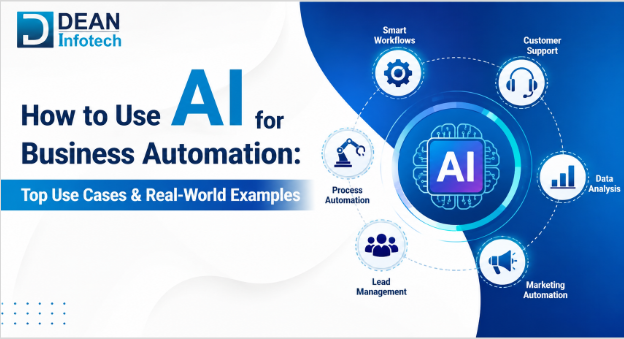
AI has now established itself as an invaluable business requirement. In all industries, from retail and banking to manufacturing and hospitality, AI is being adopted by enterprises to optimize operations, make better decisions, and ensure customers receive a quicker, more personalized service. It doesn’t replace the employees, but effectively enables them to devote a shorter time to ‘admin’ & a longer time to ‘innovation, strategy & customer’.
According to McKinsey & Company, 78% of organisations now use AI in at least one business function, up from previous years. The rapid adoption of AI is also driving increases in company expenditure on automation solutions.
From marketing, sales, HR, finance, and customer service, enterprises are transforming the way they work through the adoption of AI Business Automation. We explored how AI automations work, the technology stacks and outlined the most popular use cases enterprises are deploying in 2026.
Definition for AI Business Automation
Application of AI to automate various business functions. AI-based automation differs from rule-based automation: rule-based automation does not require AI, whereas AI-based automation can learn from data, recognise patterns, and evolve. Look at more info to explore how AI can improve business processes.
Organisations employ AI to automate processes such as lead qualification, invoicing, report writing, document management, workflow approval, predictive analytics, and customer service. By incorporating the world’s most advanced AI Automation Tools, companies can infuse their flows with intelligence, resulting in higher productivity, lower operating costs, and fewer human errors.
Why Businesses Are Investing in AI Automation
Today, businesses face massive growth in customer communications, operational data, and day-to-day administration. As an organisation expands, manual processes become bottlenecks, constraining business agility and performance. Use AI agents to automate business tasks, improve productivity, reduce manual work, and streamline daily operations.
AI automation addresses these challenges by helping organisations:
- Minimise the number of times manual tasks are duplicated
- Increase operational effectiveness
- Reduce the turnaround time of customer response
- Data-driven decisions
- Increase in scale without new staff
With AI automation initiatives, businesses will be better aware of their processes, enabling leaders to identify inefficiencies and optimise them. For enterprise-wide automation opportunities, organisations looking to digital transformation projects will benchmark Hyperautomation for Businesses.
Popular AI Business Automation Use Cases
Customer Support Automation
AI-enabled Chatbots and virtual assistants can perform many useful and must-have functionalities, such as answering generic questions, routing helpdesk tickets, providing follow-up conversation summaries, and responding to questions at any time of day. This minimises response time and, in turn, allows customer service reps to focus on more complex concerns.
Sales and Lead Management
AI helps sales teams close deals by preparing the ground for the experts to come in, which involves, at various stages, nailing down leads and the most promising ones, ranking opportunities, indicating next steps, and automating routine CRM updates. Should a company opt for an AI-enabled approach, it is likely to be more efficient and provide more personalised customer interactions.
Marketing Automation
Marketing teams use AI for search engine optimisation, content creation ideas, automated email responses, campaign personalisation, optimisation of email subject lines, segmentation (groups), social media management, and campaign analytics. These features make running campaigns easier for marketers, leading to greater efficiency and higher customer interaction. It is very convenient for sellers to use AI with marketing automation, as it makes it easier to develop campaigns and interact with customers.
Finance and Accounting
Invoice processing in finance departments is automated using AI to categorise expenses, match payments, capture invoices, detect fraud, and generate reports. These tasks are automated, decreasing human intervention.
Human Resources
From an HR perspective, they are adopting AI to route CVs automatically, schedule interviews, build chatbots to answer employees’ questions, automate the onboarding process, and analyse workforce trends, freeing up HR professionals’ time for greater employee development and strategic initiatives.
Real-World Examples of AI Business Automation
All kinds of organisations are already experiencing measurable benefits of AI automation. As the artificial intelligence interacts with you for customer interaction and stock notification, the e-commerce site might add the items you see on your computer screen to the virtual cart automatically.
AI supports providers in electronically capturing orders, scheduling appointments, communicating with patients, and documenting patient encounters. AI is also used in financial services, such as fraud detection, compliance testing, and customer onboarding.
Manufacturing corporations, for example, would use artificial intelligence (AI) to determine when their machinery needs servicing, enhance their supply chain, and track production efficiency. Specialist service companies could automate the filtering and preparation of documentation and proposals, and interact electronically with customers, freeing more expensive consultants from routine work.
Examples like these show that AI automation is so much more than chatbots. It is becoming a fundamental operational competency in virtually every sector.
Choosing the Right AI Automation Tools
When choosing suitable tools for AI Automation, the assessment of each AI Automation Tool should include three factors: business goal, current technology, and level of complexity. Companies should consider factors such as:
- Ease of integration
- Scalability
- Security and compliances
- Flexible workflow
- Analytics capabilities
- Help from the vendor
Many businesses opt for tools that combine AI capabilities with CRM, marketing automation, customer support, and workflow tools to reduce the burden of managing multiple systems.
Best Practices for Successful AI Implementation
The true value of automation comes when IA is tactically applied to the right processes, not through a blanket approach of automating everything. Organisations should look to pilot high-value, repetitive processes where automation can deliver quick wins in their operations. For example, tracking productivity, response time, and customer satisfaction is an indicator of business value, providing scope for future improvements.
De-risking human oversight is equally essential. AI should complement rather than replace human roles (more so in customer-facing and highly regulated functions). A case in point: several organisations aiming for a sustainable future are combining their resources with a large technology company to develop transformation roadmaps, implement responsible AI governance, and address traditional and future challenges of incorporating AI into enterprise systems. Dean Infotech enables its clients to identify automation opportunities and deploy scalable AI-driven solutions.
The Future of Intelligent AI Solutions
AI automation will continue to advance from the automation of specific tasks to full-fledged intelligent business orchestration. Emerging capabilities such as autonomous AI agents, predictive analytics, and real-time decision support will continue to transform businesses.
Organisations implementing Intelligent AI Solutions now are paving the way for longer-term flexibility, a premium client experience, and increased efficiency. Organisations are also exploring ways to integrate their AI efforts with Agentic AI systems to facilitate stand-alone operation with minimal human management.
Conclusion
Ventures and enterprise firms no longer own AI. Whether implemented through AI Automation Tools, Custom AI Development, or Built-in Intelligent AI Solutions, the business using AI strategically will be able to optimize operations, sidestep operational inefficiencies, and implement scalable business processes ready for future growth.
Together, mature AI and strong business processes will be a winning combination that will allow firms to beat competitors, stay ahead of the game, and create more value for customers as these new forms of AI mature.


Biltema Tools, Car and Garden Products: A Practical Owner’s Guide to Using Product Manuals

A Look at the UK’s Online Gaming Landscape

A Look at the Future of Community-Based Gaming

5 Common Questions Pet Owners Ask Veterinary Hospitals

How Family Dentists Help Caregivers Track Dental Symptoms Between Visits

Why Fixed Portions Make Weight Loss So Much Easier

What Happens After an Arrest? A Guide from Criminal Lawyers in Bankstown

A Practical Guide for Property Settlement in Springvale

Mexico City museums, parks and food markets: a culture-first itinerary

How Bigger Match Payouts Actually Change FC 27 Weekend Prep

Top 6 AI Document Processing Platforms for Enterprise Workflow Automation

How an Edit Stays Useful After the Face Paste Stops Impressing Anyone

ADA Signage: What Every Business Should Know About Interior Signs

Understanding Single-Account Gaming Platforms and Their Benefits

10 Tools To Build Visibility in AI-Driven Answers in 2026

Cove Lighting and False Ceilings: Creating a Soft, Layered Glow


Don Toliver Net Worth: Height, Age, Real Name, Career & More
Don Toliver is an American rapper and singer best known for his RIAA platinum certified songs, No Idea and After...


Finesse2tymes Net Worth: Height, Age, Real Name & Career
Finesse2tymes is an American rapper and recording artist. He is mainly recognized for his thunderous voice and motivational lyrics in...


Sugarhill Ddot Net Worth: Height, Age, Real Name & Career
Sugarhill Ddot is an American hip-hop recording artist best known for his songs, Real Facts and I Wanna Love You....


GloRilla Net Worth: Height, Age, Bio, Real Name & Career
GloRilla is an American rapper and hip-hop recording artist from Memphis. She is best known for her popular singles, “Westside...


Destroy Lonely Net Worth: Height, Age, Real Name & Career
Destroy Lonely is an American rapper best known for his 2022 mixtape, No Stylist. He is currently signed to rapper...
-
Rappers2 years ago
GloRilla Net Worth: Height, Age, Bio, Real Name & Career
-

 News2 years ago
Trash To Treasure: Maximizing Space And Efficiency Through Junk Removal
-

 Businessman3 years ago
7 Proven Lead Generation Strategies To Implement in 2023
-
 Businessman2 years ago
Brandon Fugal Net Worth: How Rich is Skinwalker Ranch Owner?
-

 Rappers4 years ago
BigXthaPlug Net Worth: Height, Age, Real Name & Career
-

 TV Stars2 years ago
Kaleb Cooper Net Worth: How Rich is the TV Star Actually?
-

 Internet Stars4 years ago
Mufti Menk Net Worth: How Rich is the Islamic Speaker Actually?
-

 TV Stars2 years ago
Carla Diab Net Worth: How Rich is the TV Star Actually in 2025?
You must be logged in to post a comment Login