
News
Sample Orders: The Cheapest Insurance a Jewelry Retailer Can Buy

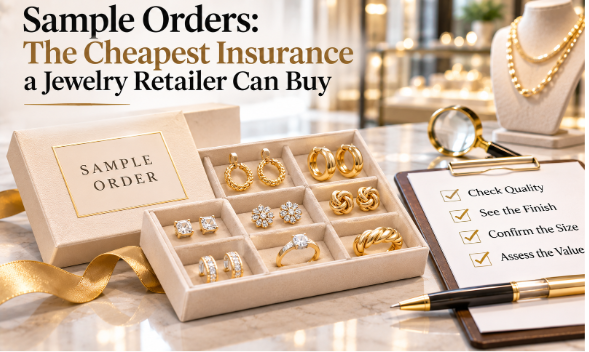
Picture a retailer who finds a catalog she likes, sees a price per gram that works, and places an order for two hundred pieces. The photos were clean. The rep was friendly on the phone. Three weeks later the box arrives, and a handful of clasps feel loose, a few earrings weigh less than the spec sheet says, and the polish looks nothing like it did on screen.
Stories like this are common enough that experienced buyers keep a standing rule: no volume order with a supplier you haven’t tested. The routine below works with any supplier, including Golden Planet USA, a supplier of gold jewelry with production in Turkey and distribution from New York’s Diamond District. It covers what a sample order should contain, what to inspect, and how to read the supplier’s behavior while you do it.
Why a sample order costs less than skipping it
A catalog shows what a piece is supposed to look like. It doesn’t show what the piece weighs, how the clasp snaps shut, or how the finish catches light across a showroom. Those details decide whether a customer buys the necklace or puts it back, and whether you spend next month handling returns.
The math is lopsided. A sample order is a dozen or so pieces. A bad bulk order is hundreds, sitting in the case at a margin you never planned for. Gold keeps its melt value, so a weak batch isn’t worthless, but selling it back as scrap means you lose the making cost, the shipping, and weeks of selling time.
There’s a second payoff people forget. A sample order is your first real transaction with the supplier. You see how fast they answer, how they pack, and whether the invoice matches the quote. No brochure tells you that.
What to put in a sample order
Ordering jewelry samples works best when you treat it as a small, deliberate copy of the order you actually plan to place, not a random grab bag.
Take one piece from every category you intend to stock: studs, hoops, chains, bracelets, rings, pendants. If you plan to carry more than one karat, take one piece in each, because 10K, 14K, and 18K differ in color and hardness, and you want to see that difference in your own hands.
Then add your heaviest and your lightest item. Problems show up at the extremes. Thin pieces bend and heavy ones expose weak clasps.
One more trick: if you already buy a similar style from another supplier, order the closest match and set the two side by side. Comparing against something you know beats judging in a vacuum.
What to check when the box arrives
If you’ve ever wondered how to check the quality of gold jewelry before buying in bulk, the answer is not complicated. It happens on a scale, under a loupe, and in daylight.
Weigh every piece on a jewelry scale and compare the result to the stated weight. A tiny gap is normal. A large one is a question for the supplier, and you want their answer in writing.
Read the stamps with a loupe. You should see a karat mark (10K, 14K, 18K, or the fineness number such as 585 for 14K) next to a maker’s mark. In the US, a quality stamp normally comes with the maker’s registered trademark, so a bare stamp with nothing beside it deserves a second look.
Open and close each clasp a dozen times. Tug lightly on chains near the solder points. Check that jump rings sit fully closed, with no visible gap.
Look at the finish under window light, not shop lights, which flatter everything. Turn rings over and check the inside. Look behind earrings. Pits, file marks, and rough casting hide in the places a catalog photo never shows.
Finally, lay three pieces of the same style next to each other. They should match in size and shape. If you plan a large order, a local jeweler with an XRF analyzer can confirm karat in a few minutes without damaging anything.
How a good wholesale supplier of gold jewelry handles sample requests
A reliable wholesale supplier of gold jewelry treats a sample request as the start of a relationship, not an interruption. You can tell within a day or two. The answers are specific, the numbers come without chasing, and nobody acts as if you’re asking for a favor.
Ask three things before you pay.
- Are samples credited toward the first order? Some suppliers do this, some don’t. Neither is wrong, but you should know before the invoice arrives.
- How long does sampling take? If pieces are made to order, ask whether your sample comes from the same line and process as the bulk run. A sample pulled from stock tells you less about a production batch.
- Will the bulk order match the sample? A good supplier explains how they keep weight and finish consistent from batch to batch, and what happens if a delivery doesn’t match. If they can’t explain it, you’ve learned something.
Put the answers in an email. A vague promise on the phone is hard to point to later.
Red flags at the sample stage
Some warning signs are loud. Most are quiet.
- The supplier dodges questions about weight or karat, or answers with “it’s all standard.”
- They won’t send a sample until you commit to a large order.
- The sample looks far better than the catalog photos. That can mean someone hand-picked the best piece in the building.
- Pieces arrive with missing stamps or no paperwork.
- The price shifts between the quote and the invoice.
- Replies take days when you haven’t paid yet. They won’t get faster after you do.
One red flag isn’t a verdict. Two or three together are.
From a good sample to a smart first order
When the samples pass, resist the urge to go big. Place a first order you could live with even if it disappoints, then run the same checks you ran on the samples: weigh, read the stamps, test the clasps, inspect the finish.
Keep the samples. Label them and put them in a drawer. They become your benchmark, the thing you hold every future delivery up against.
Raise the volume only after two orders in a row match what you saw in the first box. That feels slow. It’s cheaper than finding out at order number five that quality drifted.
Sample order checklist
Print this and keep it next to the scale.
- Pick one piece per category and one per karat you plan to carry.
- Add your heaviest and your lightest item.
- Order a close match to something you already stock, for comparison.
- Ask in writing whether samples are credited toward the first order.
- Ask how long sampling takes and whether samples match production.
- Weigh every piece and compare to the stated weight.
- Check the karat stamp and the maker’s mark with a loupe.
- Open and close every clasp, and tug chains near the solder points.
- Inspect the finish in daylight, inside rings and behind earrings.
- Compare pieces of the same style for consistent size and shape.
- Note how fast and how clearly the supplier replied.
- Keep the samples as a benchmark for future deliveries.
Final thoughts
A sample order costs a small invoice and a few evenings with a scale and a loupe. Skipping it costs nothing until the first bad batch, and then it costs a lot. Run the same routine with every new supplier, keep the samples, and let what you find decide how much to buy.


The New Financial Playbook: How Modern Athletes Are Investing Their Fortunes in 2026

What to Get the Man Who Says He Doesn’t Want Anything for Christmas

How Online Gaming Combines Humour, Imagination, and Interactive Design

Is 5G Home Internet Right for Your Household? What to Consider Before Switching

Sample Orders: The Cheapest Insurance a Jewelry Retailer Can Buy

I Tested Online Casino Games for 6 Months and Here’s What Actually Happened

Why Mobile App Testing Needs to Go Beyond Basic Test Automation

10 Creative Ways to Keep Wedding Guests Entertained

Best Boneless Sofas 2026: Cloud Comfort & No-Assembly Picks

Suncoast, Sun City & Montecasino: SA's Big Casinos vs Playing Online (2026)

What Happens After an Arrest? A Guide from Criminal Lawyers in Bankstown

Subscription fatigue: a simple review and PennyGuard

The Mental Game in Cricket: Key Strategies for Maintaining Focus and High Performance Under Pressure

Walking the Legal End of the Estate Executor Journey in Queensland

A Look at the Future of Community-Based Gaming

Your Home is Not Cash: How to Find Your Real Walk-away Net Worth

Don Toliver Net Worth: Height, Age, Real Name, Career & More
Don Toliver is an American rapper and singer best known for his RIAA platinum certified songs, No Idea and After...


Finesse2tymes Net Worth: Height, Age, Real Name & Career
Finesse2tymes is an American rapper and recording artist. He is mainly recognized for his thunderous voice and motivational lyrics in...


Sugarhill Ddot Net Worth: Height, Age, Real Name & Career
Sugarhill Ddot is an American hip-hop recording artist best known for his songs, Real Facts and I Wanna Love You....


GloRilla Net Worth: Height, Age, Bio, Real Name & Career
GloRilla is an American rapper and hip-hop recording artist from Memphis. She is best known for her popular singles, “Westside...


Destroy Lonely Net Worth: Height, Age, Real Name & Career
Destroy Lonely is an American rapper best known for his 2022 mixtape, No Stylist. He is currently signed to rapper...
-
Rappers2 years ago
GloRilla Net Worth: Height, Age, Bio, Real Name & Career
-

 News3 years ago
Trash To Treasure: Maximizing Space And Efficiency Through Junk Removal
-

 Businessman3 years ago
7 Proven Lead Generation Strategies To Implement in 2023
-
 Businessman2 years ago
Brandon Fugal Net Worth: How Rich is Skinwalker Ranch Owner?
-

 Rappers4 years ago
BigXthaPlug Net Worth: Height, Age, Real Name & Career
-

 TV Stars2 years ago
Kaleb Cooper Net Worth: How Rich is the TV Star Actually?
-

 Internet Stars4 years ago
Mufti Menk Net Worth: How Rich is the Islamic Speaker Actually?
-

 TV Stars2 years ago
Carla Diab Net Worth: How Rich is the TV Star Actually in 2025?
You must be logged in to post a comment Login