
News
Caspian Osetra Karat: The Caviar That Brought the Caspian Flavor Back

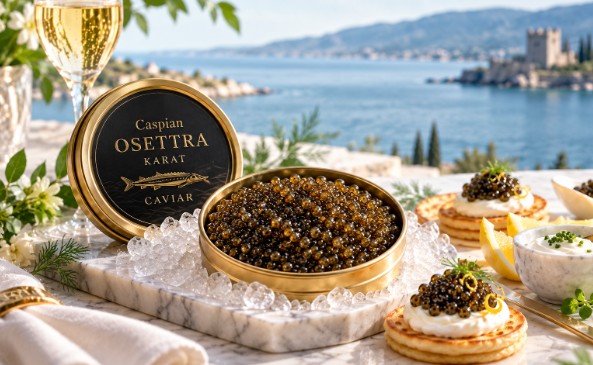
Most people who care about caviar know the Caspian Sea story by now. Wild sturgeon, centuries of trade, overfishing, collapse. International bans came in the early 2000s and wild Caspian caviar essentially stopped being a commercial product. What a lot of buyers don’t realize is that the flavor profile it carried didn’t just vanish with the industry. It came back through a different path. Karat caviar from Karat Farm in Israel is one of the clearest examples of aquaculture actually delivering on the promise of wild-equivalent quality, and it’s worth understanding why that claim holds up better here than it does with most producers.
What Made Wild Caspian Caviar So Different
The Caspian Sea is a landlocked body of water with no connection to the ocean. Over millions of years, that isolation produced unusual chemistry: high mineral content, lower salinity than seawater, stable temperature gradients at depth. Wild Russian Osetra sturgeon spent their lives in that environment, and the roe they produced absorbed those characteristics in ways that fish raised in different water simply don’t replicate.
People who tasted genuine wild Caspian Osetra describe a clean mineral backbone alongside the brine and nut notes. That mineral quality wasn’t just about the species or the genetics. It was the water. Fish living in that specific environment for decades accumulated flavor compounds that farmed equivalents raised in standard aquaculture water couldn’t match. This is why most farmed Osetra, even good farmed Osetra, tastes rounder and creamier rather than sharp and mineral. The fish are right, but the water isn’t.
Wild Osetra from older fish also developed amber coloration as the roe matured, and that amber grade carried the most complex flavor. Younger fish produce darker, blacker roe with a cleaner but less layered profile. Both were good; the amber was more interesting, and it’s why experienced buyers paid significantly more for it.
How Karat Farm in Israel Rebuilt That Standard
Karat Farm is located in Israel’s Negev desert, which sounds like an odd place for a caviar operation until you understand what’s under the ground there. The farm draws on deep underground water sources that are mineral-rich and stable in temperature year-round. The mineral profile of that water is close enough to Caspian conditions that it shows up in the finished product. This is not coincidence or marketing. It’s the reason karat caviar from Israel has a more pronounced mineral character than most farmed Osetra from European or South American operations that use surface or treated water.
The breeding stock at Karat traces directly to wild Caspian Russian Osetra. That matters because farmed sturgeon populations can drift from wild characteristics over generations if no one is managing the selection process carefully. Karat has maintained those bloodlines. Combined with the water, it means the fish are genetically the right species, growing in chemically appropriate conditions, which is as close as you can get to recreating the original Caspian environment without actually being in the Caspian.
The fish also grow slowly by commercial aquaculture standards. Most farms push growth rates to reduce time to harvest and improve economics. Karat prioritizes maturation timelines closer to what wild fish experienced, which means longer production cycles and higher costs, but also roe with more developed flavor than you get from fast-farmed equivalents.
The Technology Behind the Taste
One advantage farmed caviar has over wild that doesn’t get discussed enough is harvest timing. Wild caviar was harvested when the fish were caught, not when the roe was at peak maturity. Those two things don’t always align. Karat uses ultrasound technology to monitor roe development in individual fish and harvests at the precise window of optimal maturation. Roe taken slightly early has less developed flavor; roe taken late loses texture definition. Getting the timing right consistently is something wild fishing simply couldn’t do.
Processing follows traditional malossol preparation: minimal salt, no preservatives, immediate chilling. The tin contains roe and salt, nothing else. A lot of mid-range caviar uses additives like citric acid or borax to extend shelf life. Karat’s approach doesn’t. The trade-off is a shorter shelf life, which is fine if you’re buying fresh and eating it within the recommended window, which is what you should be doing with any non-pasteurized caviar anyway.
Amber vs Black: What the Two Grades Actually Mean
Karat osetra caviar is available in two color grades, and the difference is real, not just visual. Black Karat comes from younger fish. The pearls are dark grey to black, firm, with a clean briny flavor and a direct finish. It’s a very good caviar for regular use: clear in flavor, consistent, and easier to pair because it doesn’t demand attention the way the amber does.
Amber Karat comes from older, more mature fish that have accumulated carotenoid pigments through longer feeding cycles and maturation. The color ranges from warm brown to gold, and the flavor is more complex. The mineral note is sharper, the nuttiness is more pronounced, and the finish is longer. Experienced tasters often describe it as closer to the old wild Caspian profile than almost anything currently produced.
The price difference between grades reflects the production economics: older fish take more time and resources to bring to harvest. For an occasion where the caviar is the focus of the meal, amber is the right choice. For a weeknight where you want something excellent but not particularly ceremonial, black Karat delivers the core character at a lower entry point.
How Caspian Osetra Karat Compares to Other Premium Varieties
Against standard Royal Osetra from farms in Madagascar or Italy, Karat reads differently. Standard Royal Osetra from those operations tends toward a rounder, creamier profile with warm hazelnut notes and a generous buttery finish. Karat is sharper: more mineral, more edge, cleaner on the back palate. Neither is better in absolute terms. They’re doing different things, and which you prefer depends on whether you want refinement or character.
Against Beluga Hybrid, the comparison is almost beside the point because they’re designed for different purposes. Beluga Hybrid is about opulence: large pearls, rich butter, maximum textural drama. Karat osetra caviar is about precision and depth. Most serious buyers who get into the category eventually keep both around for different occasions rather than choosing between them.
Against Siberian Sturgeon caviar, Karat is clearly the more developed product. Siberian is a clean, reliable introduction to premium black caviar with a mild flavor that’s easy to like immediately. Karat has the complexity and the Caspian mineral character that makes it a more interesting tasting experience for anyone who has moved past the entry level. The price difference is real and in this case it reflects an actual difference in what’s in the tin.
Who Should Buy It and When
Karat makes the most sense for buyers who have some experience with premium caviar and want to understand what the Caspian reputation was actually built on. If you’ve tried Royal Osetra and want a point of comparison that’s genuinely different, Karat gives you that. The mineral character is immediately apparent to anyone paying attention, and it explains why people who tasted wild Caspian Osetra kept talking about it for years after it disappeared from the market.
It works well as a gift for someone who takes food seriously. The story behind the product, the Israeli farm, the Caspian genetics, the underground mineral water, gives the recipient something to think about while eating it. That kind of background makes a tin more interesting than price alone can.
For serving, Karat is versatile enough to eat on its own from a spoon, but it also works particularly well with simple bases that let the mineral note come through. If you want ideas beyond the basic blini and creme fraiche setup, there’s a good guide to caviar appetizers worth reading before your first serving. The amber grade especially rewards more considered presentation where guests can actually focus on what they’re tasting.
Buy the black if you want to integrate it into regular eating. Buy the amber when the occasion calls for something that will actually surprise people who think they already know what Osetra tastes like.


Caspian Osetra Karat: The Caviar That Brought the Caspian Flavor Back

How to Make Your Small Business Look More Professional

Online Gaming and Comedy Gold: Kevin Hart Takes to the (Digital) Stage

Hiring Trends in Chennai: Investment Banking + Financial Analytics Skills Are Winning in 2026

Erryn Barkett: Why Growing Assets Call for Regularly Updated Insurance Coverage

Inside the Multi-Million Dollar Gaming Economy: How Streamers and Digital Assets Drive the Virtual Currency Boom

Find the Right T-Shirt for Every Vibe

Building Sustainable Rental Success With Professional San Antonio Property Management

Safer Aging at Home: A Daily Plan for Mobility, Fall Prevention, and Peace of Mind

Teeth Whitening Options: What Actually Works
Online Gaming and Comedy Gold: Kevin Hart Takes to the (Digital) Stage

Mexico City museums, parks and food markets: a culture-first itinerary

Top 6 AI Document Processing Platforms for Enterprise Workflow Automation

ADA Signage: What Every Business Should Know About Interior Signs

How Bigger Match Payouts Actually Change FC 27 Weekend Prep

How an Edit Stays Useful After the Face Paste Stops Impressing Anyone


Don Toliver Net Worth: Height, Age, Real Name, Career & More
Don Toliver is an American rapper and singer best known for his RIAA platinum certified songs, No Idea and After...


Finesse2tymes Net Worth: Height, Age, Real Name & Career
Finesse2tymes is an American rapper and recording artist. He is mainly recognized for his thunderous voice and motivational lyrics in...


Sugarhill Ddot Net Worth: Height, Age, Real Name & Career
Sugarhill Ddot is an American hip-hop recording artist best known for his songs, Real Facts and I Wanna Love You....


GloRilla Net Worth: Height, Age, Bio, Real Name & Career
GloRilla is an American rapper and hip-hop recording artist from Memphis. She is best known for her popular singles, “Westside...


Destroy Lonely Net Worth: Height, Age, Real Name & Career
Destroy Lonely is an American rapper best known for his 2022 mixtape, No Stylist. He is currently signed to rapper...
-
Rappers2 years ago
GloRilla Net Worth: Height, Age, Bio, Real Name & Career
-

 News2 years ago
Trash To Treasure: Maximizing Space And Efficiency Through Junk Removal
-

 Businessman3 years ago
7 Proven Lead Generation Strategies To Implement in 2023
-
 Businessman2 years ago
Brandon Fugal Net Worth: How Rich is Skinwalker Ranch Owner?
-

 Rappers3 years ago
BigXthaPlug Net Worth: Height, Age, Real Name & Career
-

 TV Stars2 years ago
Kaleb Cooper Net Worth: How Rich is the TV Star Actually?
-

 Internet Stars4 years ago
Mufti Menk Net Worth: How Rich is the Islamic Speaker Actually?
-

 TV Stars2 years ago
Carla Diab Net Worth: How Rich is the TV Star Actually in 2025?
You must be logged in to post a comment Login