
News
Modular Curve Conveyor Solutions for Efficient Material Flow

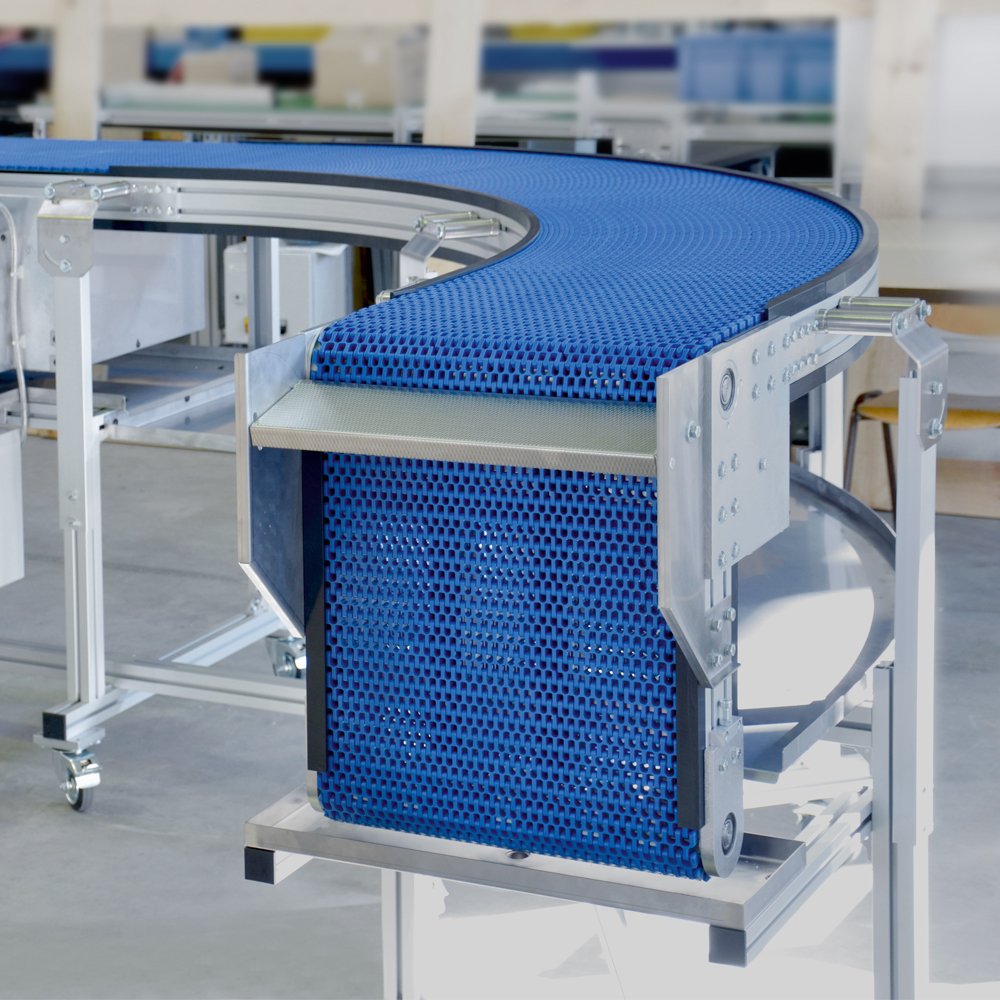
A modular curve conveyor can play an important role in modern material handling systems where products need to move efficiently around corners, between processing stations, or through limited production spaces. Unlike straight conveyor arrangements that require products to travel along a single direction, curved conveyor systems provide greater flexibility by allowing materials to change direction while remaining part of a continuous conveying process.
From food processing and packaging to warehousing and manufacturing, modular curve conveyors can help businesses create practical layouts while maintaining smooth product movement.
What Is a Modular Curve Conveyor?
A modular curve conveyor is a conveyor system designed to transport products around a curved path. It commonly uses modular components that can be assembled, adjusted, maintained, or replaced more easily than permanently integrated conveyor structures.
The conveyor belt or conveying surface follows a predetermined radius, allowing products to move through turns without requiring multiple separate straight conveyor sections.
The modular design can make these systems particularly useful for facilities that need adaptable material-handling solutions.
Why Curved Conveyors Are Useful
Traditional straight conveyors can require significant floor space when a production line needs to change direction. A curve can provide a more compact alternative.
Instead of stopping products, transferring them to another conveyor, and changing direction through a separate mechanism, a curved conveyor can guide products continuously around the required path.
This can simplify layouts and potentially reduce unnecessary transfer points.
Maximizing Available Floor Space
Factory and warehouse floor space can be expensive and limited.
A modular curve conveyor can help businesses make better use of available space by allowing conveyor routes to follow the shape of a facility.
Curves can be positioned around machinery, production areas, structural obstacles, and workstations.
This flexibility can help designers create more efficient material-flow routes without requiring every conveyor section to remain perfectly straight.
Modular Design Benefits
One of the main advantages of modular conveyor construction is flexibility.
Individual components can often be replaced or reconfigured when production requirements change.
For example, a company may expand a production line, relocate equipment, or change the direction of product flow.
A modular conveyor design can make future modifications more manageable compared with systems that are difficult to alter.
Applications in Manufacturing
Manufacturing facilities frequently move products between different stages of production.
A curved conveyor can help connect workstations without requiring large amounts of additional floor space.
Components, finished products, containers, and packaged goods can travel through curved sections while maintaining a continuous workflow.
The appropriate conveyor configuration depends on product dimensions, weight, speed, and handling requirements.
Food and Beverage Processing
Food and beverage facilities often require conveyor systems capable of handling frequent production cycles.
Modular conveyor components can be designed for applications where regular cleaning and maintenance are important.
Depending on the conveyor construction and materials selected, curved systems may be used for packaged foods, containers, trays, bottles, and other products.
Businesses should select equipment appropriate for their hygiene, temperature, washdown, and regulatory requirements.
Packaging Operations
Packaging lines often contain several stages, including filling, labeling, inspection, wrapping, and case packing.
These stations may not always be positioned in a straight line.
A modular curve conveyor can connect different stages while allowing products to change direction smoothly.
This can help create a more compact and organized packaging layout.
Warehousing and Distribution
Distribution facilities need reliable product movement between receiving, storage, sorting, packing, and shipping areas.
Curved conveyors can help route packages around structural obstacles and connect conveyor lines moving in different directions.
When combined with straight conveyors, merges, transfers, and other material-handling equipment, curved sections can become part of a larger automated transportation system.
Smooth Product Movement
A properly designed curved conveyor should maintain controlled product movement through the turn.
The conveyor’s width, belt characteristics, curve radius, speed, and side guides all influence how products behave.
Poorly matched equipment can cause products to shift, rotate unexpectedly, or become unstable.
For this reason, conveyor selection should consider the characteristics of the products being transported.
Product Size and Weight
Different products require different conveyor specifications.
Lightweight packages may behave differently from heavy boxes or irregularly shaped components.
When selecting a modular curve conveyor, businesses should consider product dimensions, weight, surface characteristics, center of gravity, and packaging.
Understanding these factors can help engineers choose a suitable conveyor configuration.
Speed and Throughput
Production requirements also influence conveyor selection.
A facility handling thousands of products per hour may require a different solution from a low-volume production environment.
The conveyor should be capable of maintaining the desired throughput without creating bottlenecks elsewhere in the system.
Speed should also be balanced with product stability and safety.
Integration With Automation
Modern material-handling systems increasingly rely on automation.
A modular curve conveyor can be integrated with sensors, controls, barcode scanners, sorting equipment, robotic systems, and other automated technologies.
Sensors can help detect products and coordinate movement between different conveyor sections.
Automation can improve consistency and reduce the need for manual product transfers.
Maintenance Considerations
Regular maintenance is important for any conveyor system.
Operators should inspect belts, rollers, bearings, guides, motors, fasteners, and other components according to manufacturer recommendations.
Modular designs can make certain maintenance tasks easier because individual components may be accessible or replaceable without rebuilding the entire system.
A preventive maintenance program can also help identify wear before it causes an unexpected shutdown.
Safety Features
Conveyor systems should be designed and operated with safety in mind.
Depending on the installation, safety features may include emergency stop mechanisms, guarding, protective covers, warning systems, and controlled access around moving components.
Employees should receive appropriate training before operating or working around conveyor equipment.
Safety requirements vary depending on the facility, equipment, and jurisdiction.
Installation Planning
Before installing a curved conveyor, businesses should evaluate the available floor space and the desired product route.
Important considerations can include:
- Conveyor width
- Curve radius
- Product dimensions
- Product weight
- Required speed
- Available space
- Loading and unloading points
- Integration with existing equipment
- Maintenance access
- Safety requirements
Careful planning can help prevent costly changes after installation.
Customization Options
Different industries have different material-handling requirements.
A modular curve conveyor may be available in different widths, materials, configurations, and curve angles.
Businesses can work with conveyor manufacturers or system integrators to develop a configuration suited to their application.
Customization can be particularly valuable when floor space is restricted or the production process has unusual routing requirements.
Reducing Manual Transfers
Every time a product is manually transferred between conveyor sections, there can be opportunities for delays, damage, or handling errors.
Curved conveyor systems can reduce some unnecessary transfers by allowing products to continue moving through a continuous route.
This can contribute to a more streamlined production process.
Improving Facility Layout
A well-planned conveyor system should support the overall workflow rather than simply moving products from one location to another.
Curved sections can help designers create routes that fit the facility’s existing architecture.
This may improve access to workstations and create a more organized movement pattern.
Selecting the Right Supplier
Choosing the right supplier is an important part of a successful conveyor project.
Businesses should consider equipment quality, engineering support, installation services, spare parts availability, maintenance assistance, and experience with similar applications.
A supplier that understands the facility’s requirements can help identify potential challenges before installation.
Long-Term Value
The initial purchase price is only one part of the total cost of a conveyor system.
Businesses should also consider energy consumption, maintenance, downtime, replacement parts, expected service life, and future expansion.
A modular design may provide long-term flexibility because components can potentially be changed as operational requirements evolve.
Conclusion
A modular curve conveyor can provide an effective solution for businesses that need to move products around corners while making efficient use of available space.
Its applications can extend across manufacturing, packaging, food processing, warehousing, and distribution.
The right system depends on product characteristics, required speed, available space, cleaning requirements, automation needs, and safety considerations.
By carefully planning the conveyor route and selecting suitable modular components, businesses can create a more flexible material-handling system. With appropriate installation and preventive maintenance, a curved conveyor can become an important part of an efficient and adaptable production or distribution operation.


Online Gaming and Comedy Gold: Kevin Hart Takes to the (Digital) Stage

Hiring Trends in Chennai: Investment Banking + Financial Analytics Skills Are Winning in 2026

Erryn Barkett: Why Growing Assets Call for Regularly Updated Insurance Coverage

Inside the Multi-Million Dollar Gaming Economy: How Streamers and Digital Assets Drive the Virtual Currency Boom

Find the Right T-Shirt for Every Vibe

Building Sustainable Rental Success With Professional San Antonio Property Management

Cove Lighting and False Ceilings: Creating a Soft, Layered Glow

How Everyday Patients Choose Between Cosmetic Upgrades and Tooth Replacement

Safer Aging at Home: A Daily Plan for Mobility, Fall Prevention, and Peace of Mind

Teeth Whitening Options: What Actually Works
Online Gaming and Comedy Gold: Kevin Hart Takes to the (Digital) Stage

BPC-157 UK: A Research-Focused Guide to the Experimental Peptide

Mexico City museums, parks and food markets: a culture-first itinerary

Top 6 AI Document Processing Platforms for Enterprise Workflow Automation

ADA Signage: What Every Business Should Know About Interior Signs

How Bigger Match Payouts Actually Change FC 27 Weekend Prep


Don Toliver Net Worth: Height, Age, Real Name, Career & More
Don Toliver is an American rapper and singer best known for his RIAA platinum certified songs, No Idea and After...


Finesse2tymes Net Worth: Height, Age, Real Name & Career
Finesse2tymes is an American rapper and recording artist. He is mainly recognized for his thunderous voice and motivational lyrics in...


Sugarhill Ddot Net Worth: Height, Age, Real Name & Career
Sugarhill Ddot is an American hip-hop recording artist best known for his songs, Real Facts and I Wanna Love You....


GloRilla Net Worth: Height, Age, Bio, Real Name & Career
GloRilla is an American rapper and hip-hop recording artist from Memphis. She is best known for her popular singles, “Westside...


Destroy Lonely Net Worth: Height, Age, Real Name & Career
Destroy Lonely is an American rapper best known for his 2022 mixtape, No Stylist. He is currently signed to rapper...
-
Rappers2 years ago
GloRilla Net Worth: Height, Age, Bio, Real Name & Career
-

 News2 years ago
Trash To Treasure: Maximizing Space And Efficiency Through Junk Removal
-

 Businessman3 years ago
7 Proven Lead Generation Strategies To Implement in 2023
-
 Businessman2 years ago
Brandon Fugal Net Worth: How Rich is Skinwalker Ranch Owner?
-

 Rappers3 years ago
BigXthaPlug Net Worth: Height, Age, Real Name & Career
-

 TV Stars2 years ago
Kaleb Cooper Net Worth: How Rich is the TV Star Actually?
-

 Internet Stars4 years ago
Mufti Menk Net Worth: How Rich is the Islamic Speaker Actually?
-

 TV Stars2 years ago
Carla Diab Net Worth: How Rich is the TV Star Actually in 2025?
You must be logged in to post a comment Login