
News
Why Skilled Recruiters Are in High Demand in 2026

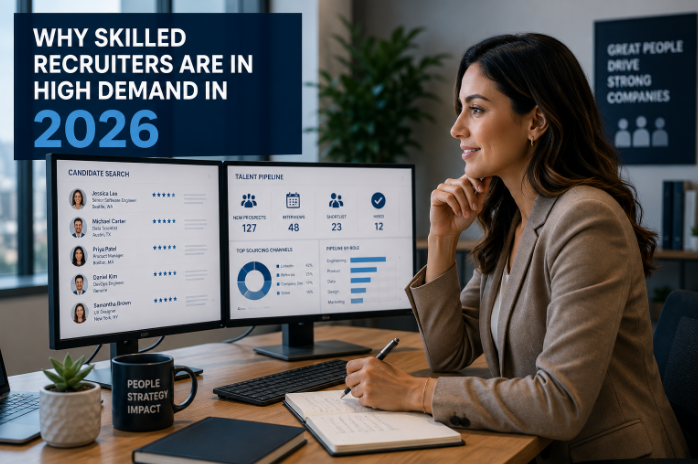
Recruiting has changed significantly over the past several years.
Employers are managing skills shortages, artificial intelligence, changing candidate expectations, tighter hiring budgets, and greater pressure to demonstrate the business value of every new employee. As a result, companies are no longer looking only for recruiters who can advertise positions and screen applications.
They need talent professionals who can understand business priorities, identify hard-to-find candidates, evaluate skills, advise hiring managers, use recruiting technology responsibly, and improve the quality of hiring decisions.
This shift helps explain why recruiter demand remains strong in 2026, particularly for professionals with specialized knowledge and a strategic approach to talent acquisition.
The demand is not necessarily based on companies hiring at any cost or expanding every recruiting department. Instead, employers are becoming more selective. They want recruiters who can produce better outcomes in a more complicated labor market.
The U.S. Employment Outlook Supports Continued Recruiter Demand
Recruiters are generally included within the broader human resources specialist occupation tracked by the U.S. Bureau of Labor Statistics.
The BLS projects employment of human resources specialists to grow 6% from 2024 through 2034, faster than the projected average for all U.S. occupations. It also expects approximately 81,800 openings each year, on average, over that period. These openings include both newly created positions and vacancies caused by workers leaving the occupation or labor force.
Recruitment specialists, also known as recruiters or talent acquisition specialists, are specifically identified by the BLS as professionals who find, screen, and interview candidates for organizational job openings.
The agency also states that demand for HR specialists is expected to remain strong as organizations rely on them to support strategic priorities.
However, these projections do not mean that every recruiter will experience the same level of opportunity.
Recruiters who depend entirely on incoming applications or basic administrative processes may face greater competition. Those who can manage specialized searches, build pipelines, interpret data, advise leaders, and use modern technology are likely to provide more value.
Hiring Has Become More Selective, Not Less Important
Many U.S. employers entered 2026 with a cautious approach to headcount.
Economic uncertainty and pressure to improve productivity have caused some organizations to delay hiring, consolidate roles, or closely review whether a new position is necessary. SHRM described the beginning of 2026 as a constrained hiring environment in which organizations are focusing more heavily on precision than large-scale recruiting activity.
At first, that may appear to reduce recruiter demand.
In practice, selective hiring can make skilled recruiters even more important. When an organization is filling fewer positions, each hire may receive greater scrutiny. Hiring managers want stronger candidate alignment, clearer evidence of qualifications, and better confidence that a new employee will remain and perform successfully.
Recruiters must therefore produce quality rather than simply activity.
They are increasingly expected to answer questions such as:
- Which skills are truly required for the position?
- Where can qualified candidates be found?
- Is the compensation competitive?
- Are the requirements unnecessarily limiting the talent pool?
- How should candidates be evaluated consistently?
- What is causing qualified people to leave the process?
- How will the organization measure the success of the hire?
A recruiter who can provide credible answers becomes a strategic resource rather than an administrative service.
Skills Shortages Are Increasing the Value of Experienced Recruiters
Organizations continue to struggle with mismatches between the skills they need and the skills available in the labor market.
The World Economic Forum reports that 63% of surveyed employers consider skills gaps a major barrier to business transformation. It also found that 70% expect to hire employees with new skills as organizations respond to changing technology and business requirements.
This environment creates difficult recruiting assignments.
Companies may need candidates with experience in artificial intelligence, cybersecurity, healthcare, engineering, advanced manufacturing, finance, or other specialized areas. Some of these professionals are already employed and may not be applying through public job boards.
Skilled recruiters know how to research these markets, identify potential candidates, and conduct personalized outreach.
They also help hiring managers distinguish between qualifications that are essential and those that are merely preferred. This can prevent organizations from creating unrealistic job descriptions that unnecessarily reduce the available candidate pool.
The ability to understand a specialized talent market is one of the clearest reasons recruiter demand remains strong.
Artificial Intelligence Is Changing Recruiter Responsibilities
AI is automating parts of the recruitment process, but it is not eliminating the need for capable recruiters.
Recruiting teams can now use technology to assist with job descriptions, candidate research, communication, scheduling, note-taking, reporting, and other repetitive tasks.
LinkedIn’s Future of Recruiting research found that 37% of surveyed talent acquisition professionals were experimenting with or integrating generative AI into their work. Those using it reported saving an average of approximately 20% of their workweek.
That efficiency changes where recruiters spend their time.
Instead of focusing primarily on administrative activity, recruiters can devote more attention to candidate assessment, hiring manager consultation, pipeline development, and relationship building.
LinkedIn also reported that employers were significantly more likely to include relationship development as a required recruiter skill than in the previous year.
This suggests that AI is raising expectations rather than simply reducing headcount.
Employers need recruiters who understand how to use technology without allowing it to weaken candidate experience, introduce poor assumptions, or replace professional judgment.
The strongest recruiters know when automation is useful and when human involvement is essential.
Skills-Based Hiring Requires Better Recruiters
Employers are increasingly interested in evaluating what candidates can do rather than relying only on degrees, titles, or the reputation of previous employers.
This approach can expand the talent pool and uncover qualified candidates who might otherwise be overlooked.
However, skills-based hiring is not as simple as removing education requirements from a job description.
Recruiters must work with hiring managers to define the actual skills connected to successful performance. They may also help develop interview questions, work samples, scorecards, and other assessment methods.
LinkedIn reported that 93% of surveyed talent acquisition professionals considered accurate skills assessment important for improving quality of hire. Organizations using skills-focused candidate searches were also more likely to report quality hiring outcomes.
This creates demand for recruiters who can evaluate evidence rather than search only for familiar keywords.
A skilled recruiter can recognize transferable experience, ask detailed questions, and explain why a candidate from a different industry or background may still be well suited to the role.
Specialized Recruiters Can Reach Candidates Generalists May Miss
Recruiter demand is particularly strong in areas where talent is limited or qualifications are difficult to evaluate.
A technical recruiter must understand engineering positions well enough to distinguish between different technologies, environments, and levels of responsibility.
A healthcare recruiter may need familiarity with licensing, clinical specialties, workplace settings, and regional candidate availability.
An executive recruiter must evaluate leadership scope, decision-making authority, business results, organizational fit, and the candidate’s ability to work with boards or investors.
Other specialized areas include:
- Manufacturing and engineering
- Finance and accounting
- Human resources leadership
- Sales and revenue positions
- Cybersecurity
- Artificial intelligence and data
- Legal and compliance
- Supply chain and operations
Industry knowledge allows a recruiter to communicate more credibly with candidates and hiring managers.
It also helps the recruiter identify why a search is struggling. The issue may involve compensation, location, job scope, employer reputation, workplace requirements, or unrealistic experience expectations.
Recruiters Are Becoming Strategic Talent Advisors
SHRM’s 2026 research encourages organizations to think of recruiters as “Talent Architects” who help design the workforce rather than simply process job openings.
In a survey of 1,268 recruitment-focused HR professionals, SHRM found that 63% of organizations identified developing a critical-talent sourcing strategy as a leading priority for 2026. The report emphasizes data-informed recruiting, skills-based hiring, strategic sourcing, and stronger alignment between recruitment and business objectives.
This broader role requires recruiters to understand why the organization is hiring.
Instead of immediately beginning candidate outreach, a strategic recruiter may ask:
- What business result should this position produce?
- Is a new hire the best solution?
- Which capabilities are missing from the current team?
- Could the position be redesigned?
- Is the available compensation realistic?
- Which talent markets should be targeted?
- What would cause a strong candidate to accept the opportunity?
These conversations can prevent wasted time and improve the final hiring decision.
Recruiters who are willing and able to challenge unclear requirements are often more valuable than those who simply accept every job description as written.
Candidate Experience Has Become a Business Concern
Candidates evaluate employers throughout the recruitment process.
Delayed communication, disorganized interviews, unclear responsibilities, and repeated changes can cause qualified candidates to withdraw. Poor experiences can also affect an organization’s reputation among customers, professional communities, and future applicants.
Skilled recruiters help maintain a consistent process.
They explain next steps, prepare candidates for interviews, gather feedback, address concerns, and keep hiring managers informed. They also recognize when delays or unclear expectations are putting a placement at risk.
SHRM reported that 69% of organizations continued to experience difficulty filling full-time positions, with common problems including insufficient applicants, employer competition, and candidates ending communication during the process.
A recruiter cannot control every market condition, but effective communication and process management can reduce avoidable candidate loss.
Data Skills Are Becoming Essential in Recruiting
Recruiting decisions increasingly require more than intuition.
Organizations want to understand where candidates are coming from, how long searches take, why applicants withdraw, which stages create delays, and whether new employees perform successfully.
Modern recruiters may work with data related to:
- Candidate source effectiveness
- Time to interview
- Time to fill
- Offer acceptance
- Interview conversion
- Candidate withdrawal
- Recruiting costs
- Quality of hire
- Retention
- Workforce representation
The goal is not simply to produce reports.
Recruiters must interpret the information and recommend practical changes. For example, a high number of applicants may appear positive, but it may indicate that the job advertisement is attracting people who do not meet the essential requirements.
A low offer-acceptance rate may reveal a compensation problem, a lengthy interview process, unclear job expectations, or weak communication.
Recruiters who can turn hiring data into business recommendations are likely to remain valuable even as routine recruiting tasks become automated.
Employers Need Recruiters Who Can Influence Hiring Managers
Recruiting success depends heavily on hiring manager behavior.
Even an experienced recruiter may struggle when managers delay feedback, repeatedly change requirements, reject candidates without clear explanations, or conduct inconsistent interviews.
Strong recruiters know how to establish productive working relationships with managers.
They use intake meetings to define requirements, explain labor-market conditions, agree on responsibilities, and establish a realistic timeline. They can also challenge assumptions respectfully when expectations are limiting the search.
This ability requires communication, credibility, judgment, and confidence.
It is one of the most difficult recruiting skills to automate and one of the most important qualities employers should evaluate when hiring a recruiter.
Internal and Agency Recruiters Are Both Needed
Recruiter demand exists across both internal talent acquisition departments and external recruitment firms.
Internal recruiters offer dedicated knowledge of one organization. They learn its leadership team, culture, compensation, systems, and long-term workforce plans.
Agency recruiters provide flexibility, specialized market knowledge, and access to candidates beyond the company’s existing network. They can be particularly useful for confidential, urgent, executive, or difficult-to-fill positions.
Many organizations use both.
An internal team may manage recurring positions while outside recruiters support specialized assignments, leadership searches, or temporary increases in hiring activity.
The most effective model depends on the organization’s hiring volume, internal resources, industry, and position complexity.
The Recruiter Skills Employers Value in 2026
Recruiters who want to remain competitive should develop capabilities beyond basic applicant management.
Important recruiter skills in 2026 include:
- Direct sourcing and passive-candidate outreach
- Hiring manager consultation
- Skills-based candidate evaluation
- Recruitment technology and AI literacy
- Data interpretation
- Industry or functional specialization
- Candidate relationship management
- Interview process design
- Employer-brand communication
- Offer and closing support
No recruiter will be equally strong in every area.
Employers should identify which capabilities matter most for their environment and evaluate candidates against those priorities.
When Employers Need Help Hiring Recruiting Talent
Organizations may find that hiring a strong recruiter is nearly as difficult as filling the positions that recruiter will eventually manage.
Experienced talent acquisition professionals are often already employed, and the best candidates may not be actively applying through public job boards.
A specialized recruiter hiring firm can help define the position, identify active and passive candidates, evaluate recruiting capabilities, and support the employer through final selection.
This approach may be especially useful when hiring a senior recruiter, recruiting manager, talent acquisition director, technical recruiter, executive recruiter, or another specialized talent professional.
Recruiter Demand Is Shifting Toward Higher-Value Skills
The future of recruiting is not based solely on processing more applications.
It is based on making better hiring decisions.
Employers in 2026 need recruiters who can find specialized talent, understand changing skills, use technology intelligently, build relationships, interpret data, and advise business leaders.
Automation will continue to change how recruiting work is performed. Some repetitive activities will become faster and require less manual effort.
However, the need for judgment, communication, market knowledge, and human connection remains.
That is why skilled recruiters continue to be in demand, even in a selective and rapidly changing hiring environment.


10 Actionable Steps to Increase Amazon Brand Visibility This Year

Who Keeps the Jackpot? How Gambling Winnings Are Taxed in the US, the UK and Denmark

Finding Games Repetitive? Baccarat Variations Can Offer Different Experiences

What to Check Before Connecting Any MCP Server to Your Account

Step-by-Step Instructions to Check Winning Numbers on Web Portals

Corporate Gifts for Better Business Brand Promotion Now

Understanding Single-Account Gaming Platforms and Their Benefits

How Pay Per Lead Loan Affiliate Programs Create New Revenue Opportunities

Safer Aging at Home: A Daily Plan for Mobility, Fall Prevention, and Peace of Mind

Teeth Whitening Options: What Actually Works

BPC-157 UK: A Research-Focused Guide to the Experimental Peptide

Online Gaming and Comedy Gold: Kevin Hart Takes to the (Digital) Stage

Mexico City museums, parks and food markets: a culture-first itinerary

The Goplay711 Difference: Why Live Casino Players Are Switching

What are the Benefits of Receiving Healthcare Services at Home?

How Trauma Therapy Works: Methods, Timelines & What to Expect


Don Toliver Net Worth: Height, Age, Real Name, Career & More
Don Toliver is an American rapper and singer best known for his RIAA platinum certified songs, No Idea and After...


Finesse2tymes Net Worth: Height, Age, Real Name & Career
Finesse2tymes is an American rapper and recording artist. He is mainly recognized for his thunderous voice and motivational lyrics in...


Sugarhill Ddot Net Worth: Height, Age, Real Name & Career
Sugarhill Ddot is an American hip-hop recording artist best known for his songs, Real Facts and I Wanna Love You....


GloRilla Net Worth: Height, Age, Bio, Real Name & Career
GloRilla is an American rapper and hip-hop recording artist from Memphis. She is best known for her popular singles, “Westside...


Destroy Lonely Net Worth: Height, Age, Real Name & Career
Destroy Lonely is an American rapper best known for his 2022 mixtape, No Stylist. He is currently signed to rapper...
-
Rappers2 years ago
GloRilla Net Worth: Height, Age, Bio, Real Name & Career
-

 News2 years ago
Trash To Treasure: Maximizing Space And Efficiency Through Junk Removal
-

 Businessman3 years ago
7 Proven Lead Generation Strategies To Implement in 2023
-
 Businessman2 years ago
Brandon Fugal Net Worth: How Rich is Skinwalker Ranch Owner?
-

 Rappers3 years ago
BigXthaPlug Net Worth: Height, Age, Real Name & Career
-

 TV Stars2 years ago
Kaleb Cooper Net Worth: How Rich is the TV Star Actually?
-

 Internet Stars4 years ago
Mufti Menk Net Worth: How Rich is the Islamic Speaker Actually?
-

 TV Stars2 years ago
Carla Diab Net Worth: How Rich is the TV Star Actually in 2025?
You must be logged in to post a comment Login